3D Gallery
Earth From Space
Enter gallery
Earth From Space is a 3D virtual gallery on MyGallery3D, a walkable online exhibition of 18 works. Step inside and explore it in your browser: no app, no headset.
A 3D virtual gallery of our own planet, seen from orbit. Hurricanes from above, rivers braided across deserts, city lights at night, and the thin blue line of atmosphere that holds all of it in.
Every image in this online exhibition was made by NASA and is in the public domain. Each label carries the mission or observatory that captured it, the date, and a link to read more.
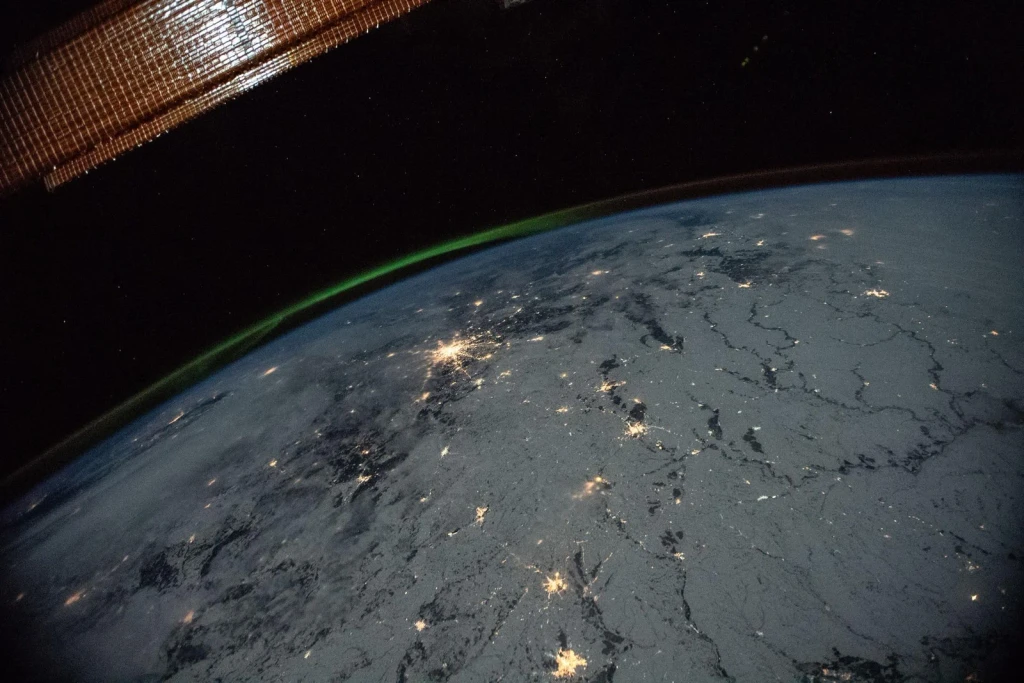
A portion of the International Space Station's solar arrays caps this nighttime view of the Earth's limb with an aurora as the orbital complex orbited 258 miles above Ukraine and Russia.
(iss058e005282, Jan. 19, 2019)
NASA · JSC · 2019-01-18 · Aurora on Wikipedia
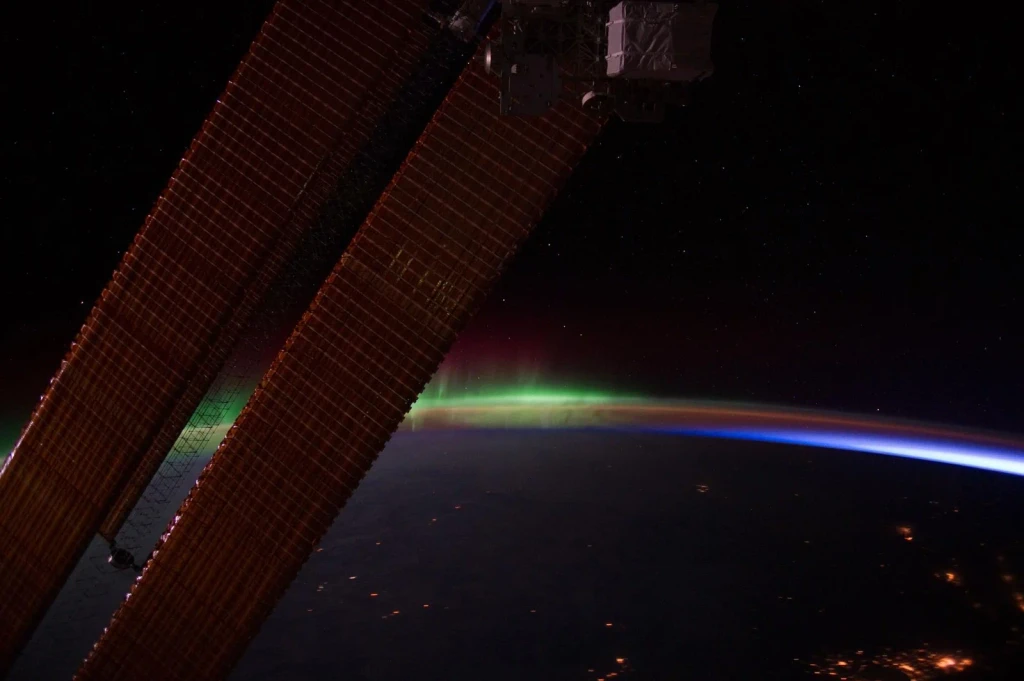
ISS030-E-075182 (4 Feb. 2012)
This nighttime view of Earth's horizon and scattered city lights was photographed by one of the Expedition 30 crew members aboard the International Space Station. Activity of Aurora Borealis appears from behind one of the orbital outpost's solar array panels, then fades into an area where Earth's limb is visible and finally a small "slice" of daybreak appears at right.
NASA · JSC · 2012-02-04 · Aurora on Wikipedia
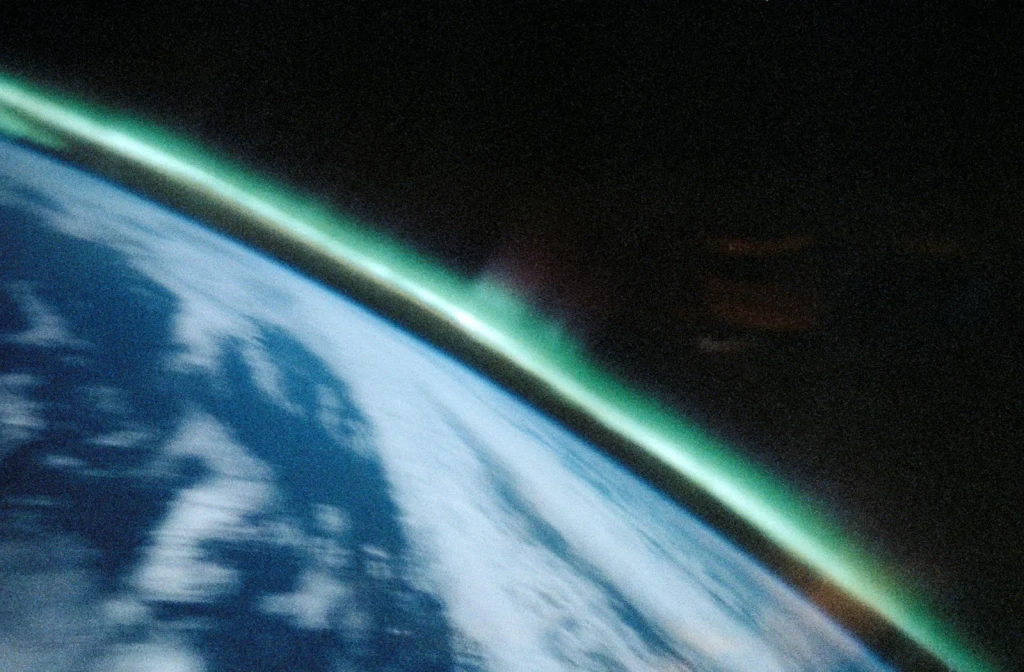
A 35mm frame of the Aurora Australis, also known as the Southern Lights, photographed from the Space Shuttle Discovery's flight deck by one of its seven crew members.
One of the mission objectives was to measure the spectral and spatial characteristics of auroral emissions. While passing over the sunlit portion of Earth, the crew was able to take a number of photos of the various geographic points on the planet; much of the time on nightside passes was devoted to a thorough study and documentation of auroral displays.
(STS039-25-006, 28 April, 6 May 1991)
NASA · JSC · 1991-05-06 · Aurora on Wikipedia
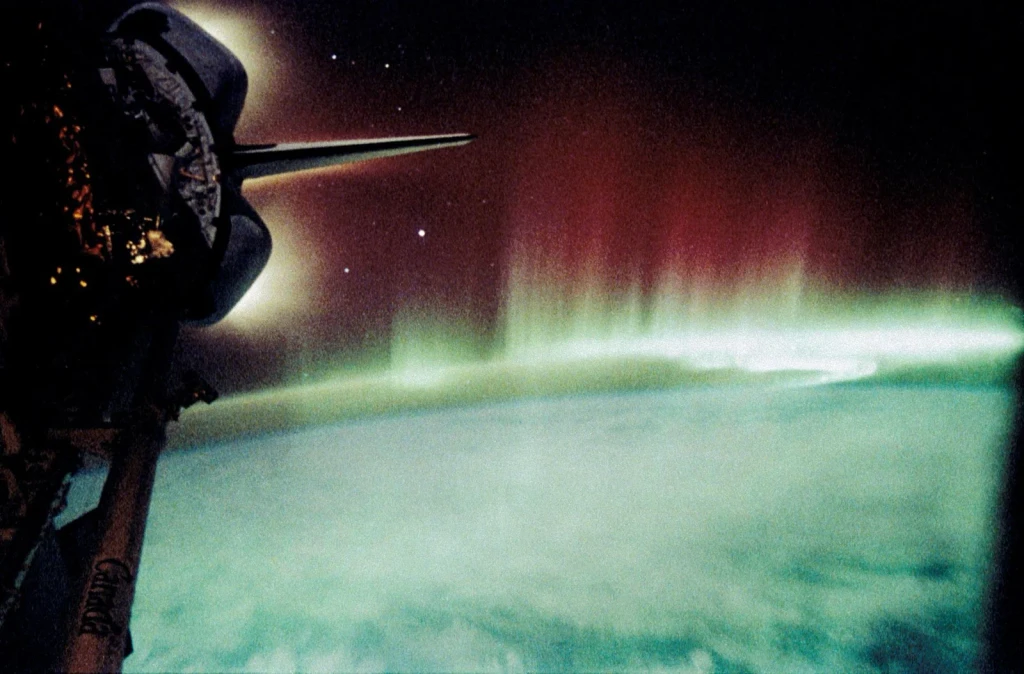
This view of the Aurora Australis, or Southern Lights, shows a band of airglow above the limb of Earth. Photo experts at NASA studying the mission photography identify the airglow as being in the 80, 120 kilometer altitude region and attribute its existence to atomic oxygen (wavelength of 5,577 Angstroms), although other atoms can also contribute.
The atomic oxygen airglow is usually most intense at altitudes around 65 degrees north and south latitude, and is most intense in the spring and fall of the year. The aurora phenomena is due to atmospheric oxygen and nitrogen being excited by the particles from the Van Allen Radiation belts which extend between the two geomagnetic poles.
The red and green rays appear to extend upward to 200, 300 kilometers, much higher than the usual upper limits of about 110 kilometers.
(STS039-342-026, 28 April, 6 May 1991)
NASA · JSC · 1991-05-06 · Aurora on Wikipedia
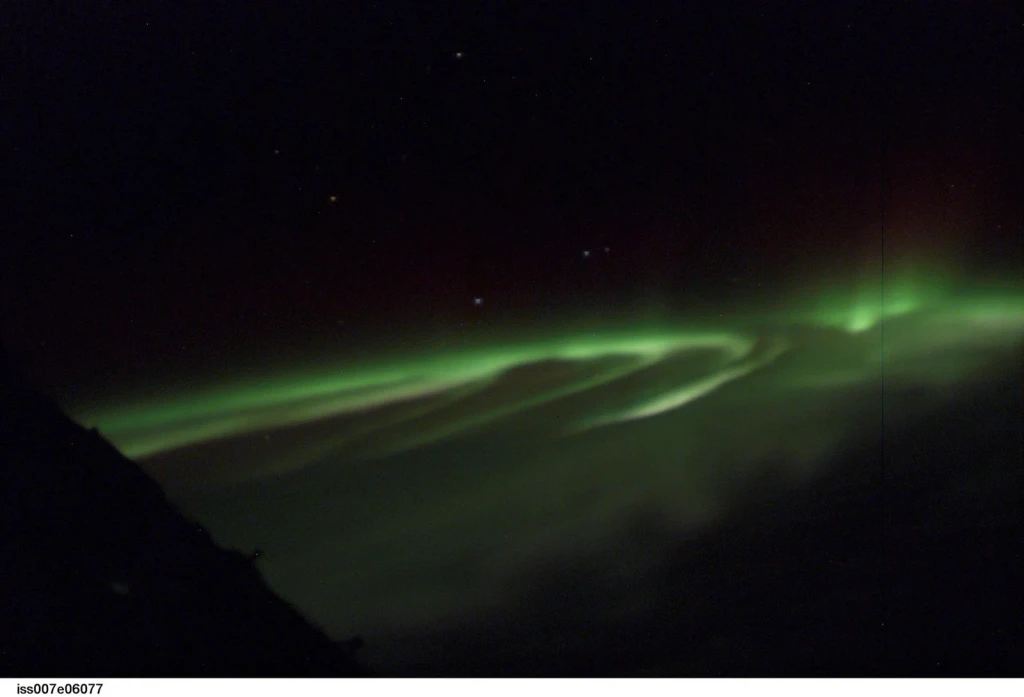
ISS007-E-06077 (3 June 2003) --- This view featuring the Aurora Australis or “southern lights” was photographed by astronaut Edward T. Lu, Expedition 7 NASA ISS science officer and flight engineer aboard the International Space Station (ISS). When this was taken, the Station was in a position over the Indian Ocean, southwest of Australia. The four stars hanging above Earth’s limb are the brightest stars of the southern constellation Corvus.
NASA · JSC · 2003-06-03 · Aurora on Wikipedia
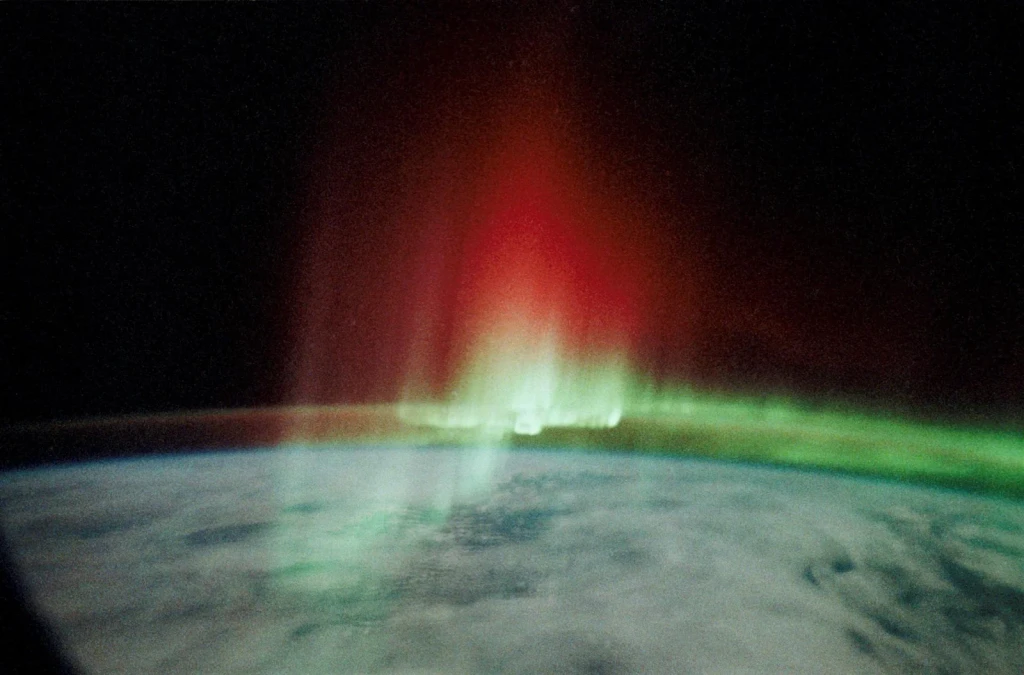
A 35mm frame of the Aurora Australis, also known as the Southern Lights, photographed from the Space Shuttle Discovery's flight deck by one of its seven crew members.
One of the mission objectives was to measure the spectral and spatial characteristics of auroral emissions. While passing over the sunlit portion of Earth, the crew was able to take a number of photos of the various geographic points on the planet; much of the time on nightside passes was devoted to a thorough study and documentation of auroral displays.
(STS039-23-036, 28 April, 6 May 1991)
NASA · JSC · 1991-05-06 · Aurora on Wikipedia
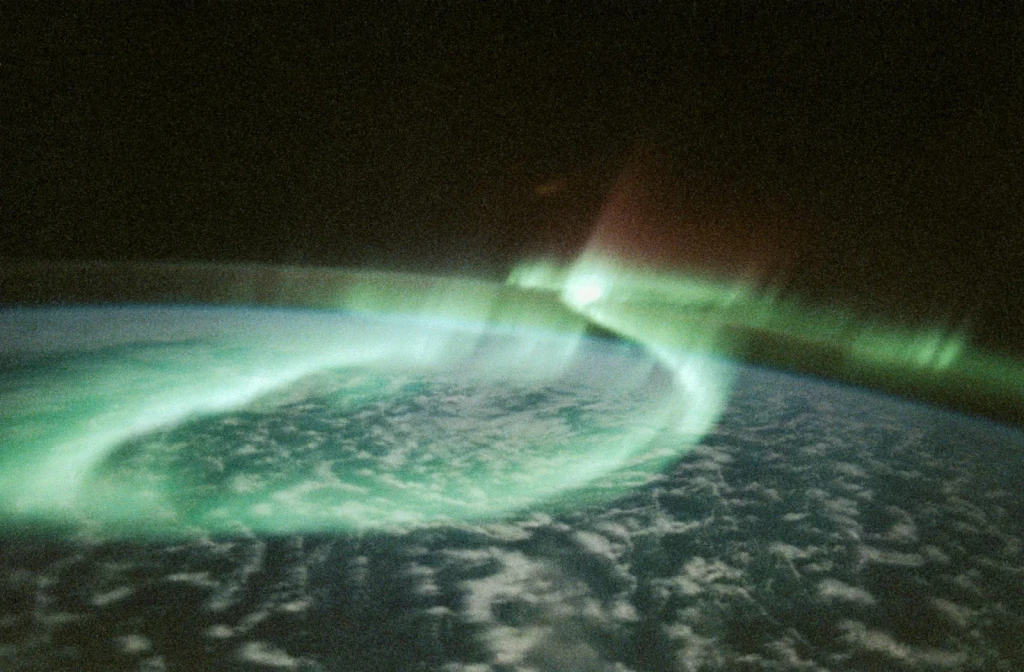
STS039-23-020 (28 April, 6 May 1991)
A 35mm frame of the Aurora Australis, also known as the Southern Lights, photographed from Space Shuttle Discovery's flight deck by one of its seven crew members. One of the mission objectives was to measure the spectral and spatial characteristics of auroral emissions.
While passing over the sunlighted portion of Earth, the crew was able to take a number of photos of the various geographic points on the planet; much of the time on nightside passes was devoted to a thorough study and documentation of auroral displays.
NASA · JSC · 1991-05-06 · Aurora on Wikipedia
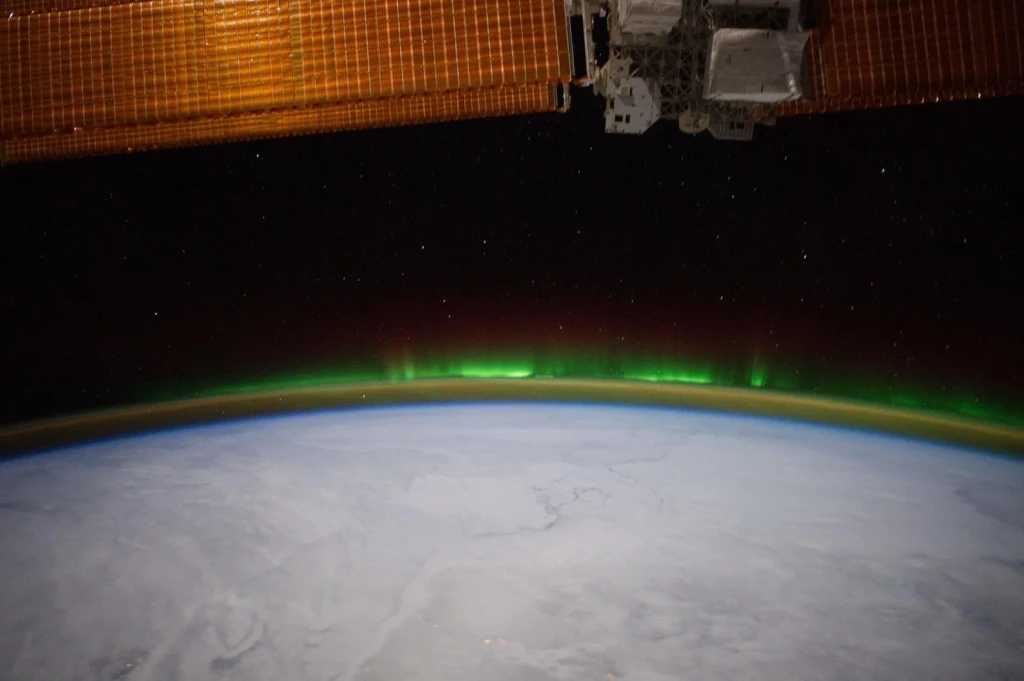
ISS030-E-114095 (6 Feb. 2012). Minor activity of Aurora Borealis is easily recognized "piggybacking" Earth's limb in this 24-mm image photographed by one of the Expedition 30 crew members aboard the International Space Station from approximately 240 miles above Earth. Clouds obscure what would be any recognizable points on the planet.
A section of one of the solar array panels on the orbital outpost is seen across the top of the frame.
NASA · JSC · 2012-02-06 · Aurora on Wikipedia
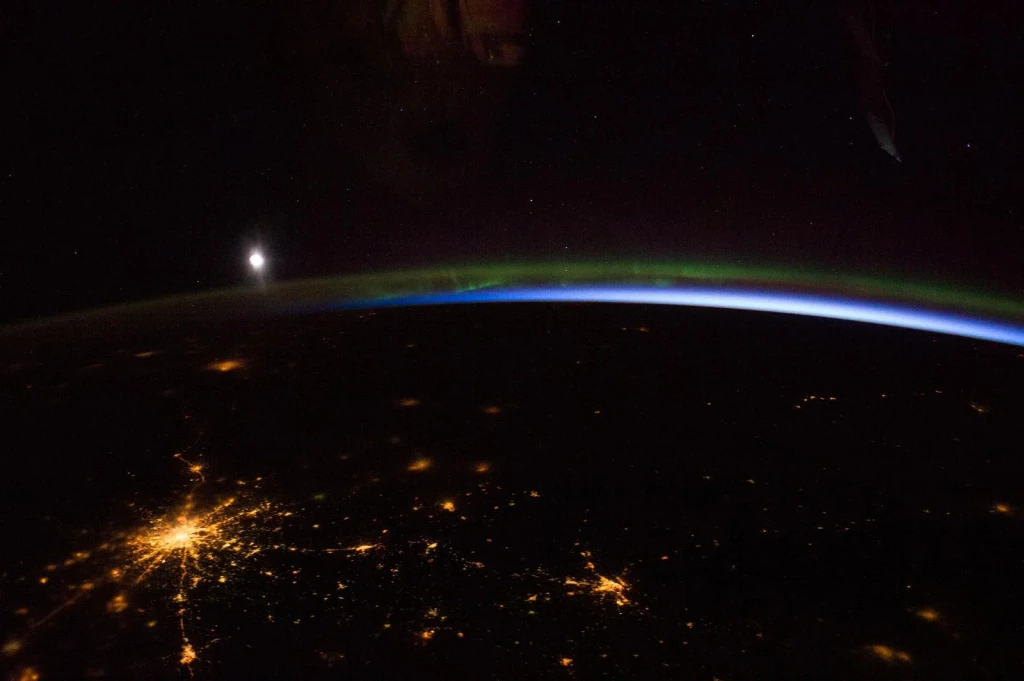
ISS039-E-009160 (2 April 2014) --- This nighttime view featuring the aurora borealis, the moon and Moscow was photographed by an Expedition 39 crew member on the International Space Station. A thin green line of the aurora borealis crosses the top of this image. The moon appears as a white disc just above the aurora. Airglow appears as a blue-white cusp on Earth's limb. Russia's capital city Moscow makes a splash of yellow (lower left), with its easily recognized radial pattern of highways. Other cities are Nizhni Novgorod (lower center) 400 kilometers from Moscow, St. Petersburg (left) 625 kilometers from Moscow, and Finland?s capital city Helsinki.
NASA · JSC · 2014-04-02 · Aurora on Wikipedia
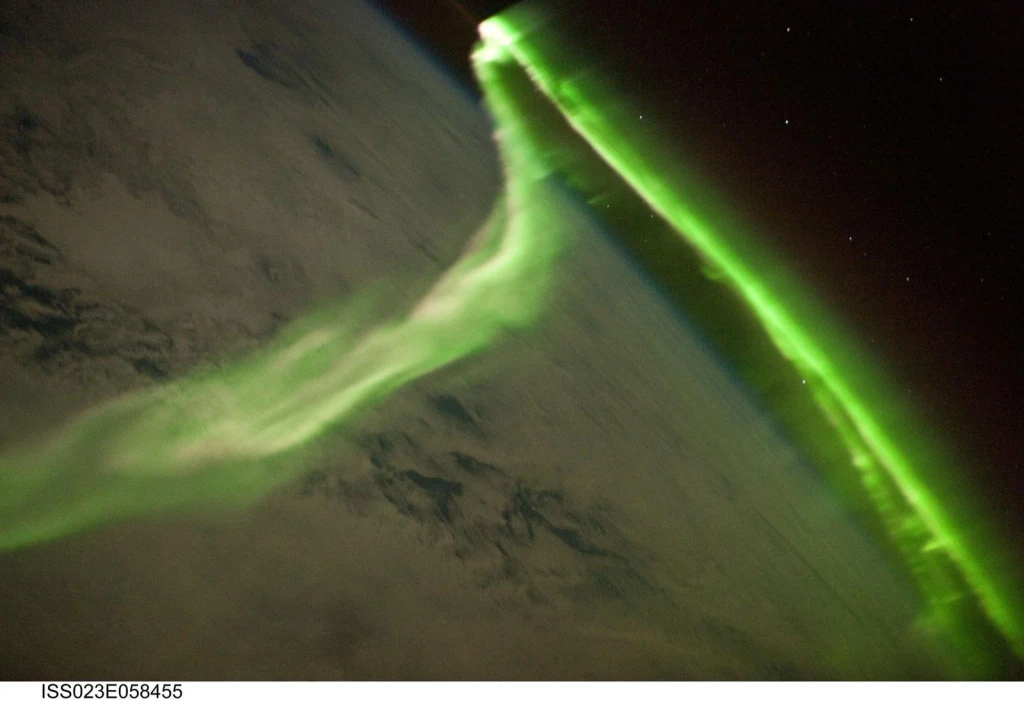
ISS023-E-058455 (29 May 2010) --- Aurora Australis is featured in this image photographed by an Expedition 23 crew member on the International Space Station. Among the views of Earth afforded crew members aboard the ISS, surely one of the most spectacular is of the aurora. These ever-shifting displays of colored ribbons, curtains, rays, and spots are most visible near the North (Aurora Borealis) and South (Aurora Australis) Poles as charged particles streaming from the sun (the solar wind) interact with Earth’s magnetic field, resulting in collisions with atoms of oxygen and nitrogen in the upper atmosphere. The atoms are excited by these collisions, and typically emit photons as a means of returning to their original energy state. The photons form the aurora that we see. The most commonly observed color of aurora is green, caused by photons (light) emitted by excited oxygen atoms at wavelengths centered at 0.558 micrometers, or millionths of a meter. Visible light is reflected from healthy (green) plant leaves at approximately the same wavelength. Red auroras are generated by light emitted at a longer wavelength (0.630 micrometers), and other colors such as blue and purple are also sometimes observed. While auroras are generally only visible close to the poles, severe magnetic storms impacting Earth’s magnetic field can shift them towards the equator. This striking aurora image was taken during a geomagnetic storm that was most likely caused by a coronal mass ejection from the sun on May 24, 2010. The ISS was located over the Southern Indian Ocean at an altitude of 350 kilometers, with the observer most likely looking towards Antarctica (not visible) and the South Pole. The aurora has a sinuous ribbon shape that separates into discrete spots near the lower right corner of the image. While the dominant coloration of the aurora is green, there are faint suggestions of red photon emission as well (light fuscia tones at center left). Dense cloud cover is dimly visible below the aurora. The curvature of Earth’s horizon, or limb, is clearly visible as is the faint blue line of the upper atmosphere directly above at top center. Several stars appear as bright pinpoints against the blackness of space at top right.
NASA · JSC · 2010-05-29 · Aurora on Wikipedia
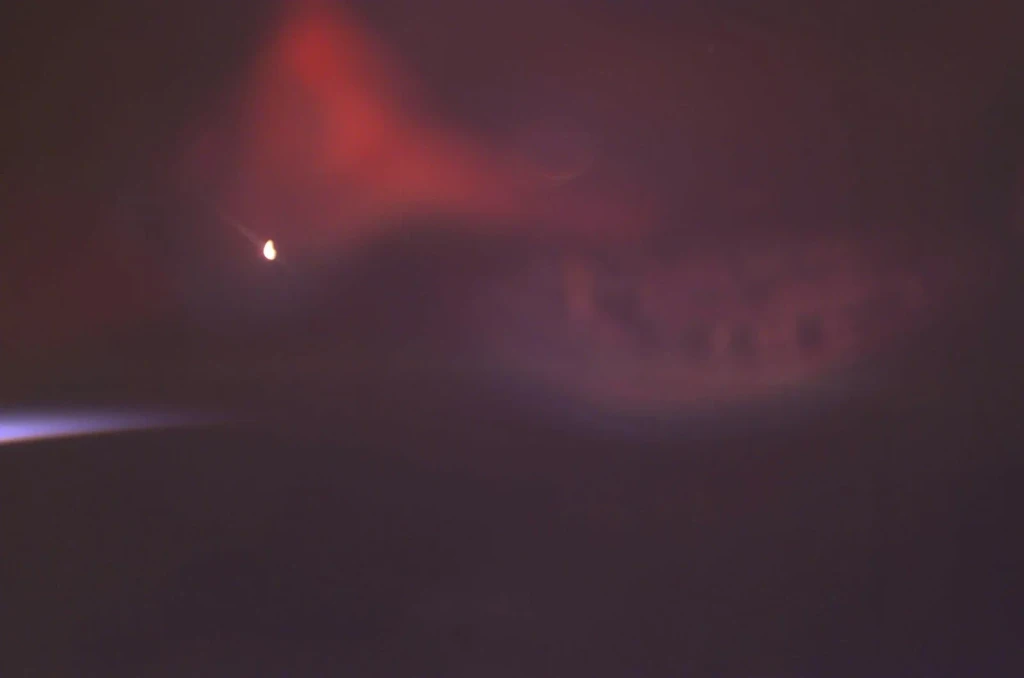
Auroras are caused when high-energy electrons pour down from the Earth's magnetosphere and collide with atoms. Red aurora, as captured here by a still digital camera aboard the International Space Station, occurs from 200 km to as high as 500 km altitude and is caused by the emission of 6300 Angstrom wavelength light from oxygen atoms. The light is emitted when the atoms return to their original unexcited state.
The white spot in the image is from a light on inside of the ISS that is reflected off the inside of the window. The pale blue arch on the left side of the frame is sunlight reflecting off the atmospheric limb of the Earth. At times of peaks in solar activity, there are more geomagnetic storms and this increases the auroral activity viewed on Earth and by astronauts from orbit.
NASA · MSFC · 2001-10-01 · Aurora on Wikipedia
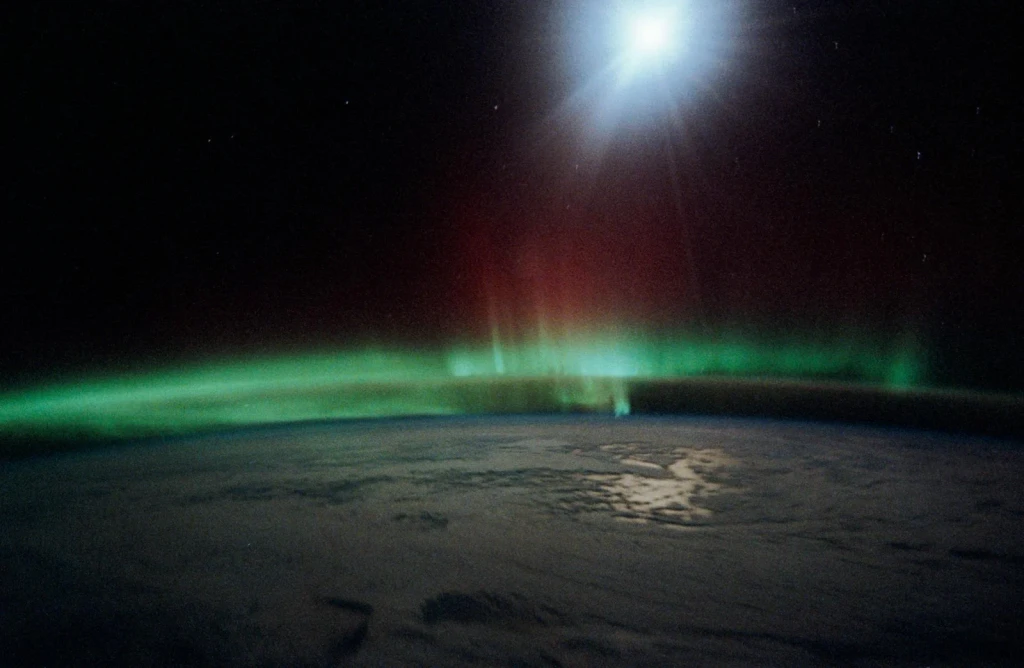
STS039-377-013 (28 April, 6 May 1991)
Moonlight saturates the high speed film used for auroral photography. Moon glint is visible in the open ocean and the cloud patterns are well illuminated. This frame was taken with a handheld 35mm camera from inside the Space Shuttle Discovery's crew cabin.
This is one of 25 visuals used by the STS-39 crew at its May 17, 1991 Post Flight Press Conference. Discovery's flight of eight days duration, launched April 28, 1991 from Kennedy Space Center and completed on May 6, 1991 at the KSC landing facility, was dedicated to the Department of Defense. Crew members were astronauts Michael L. Coats, L. Blaine Hammond, Guion S. Bluford, Richard J. Hieb, Gregory J. Harbaugh, Donald R. McMonagle and Charles L. (Lacy) Veach.
NASA · JSC · 1991-05-06 · STS-39 on Wikipedia
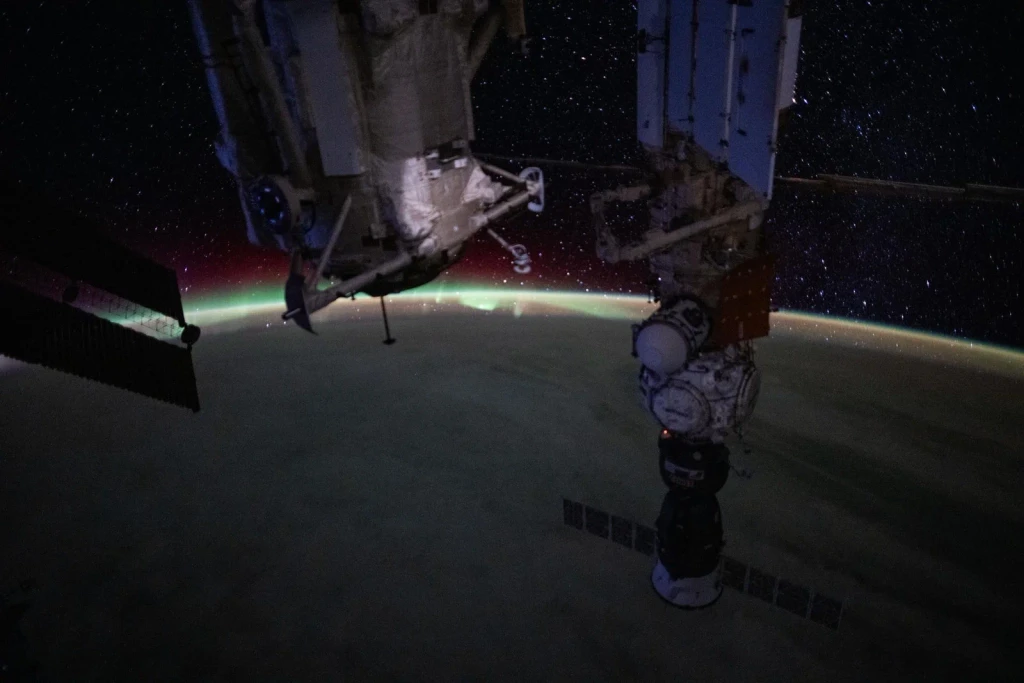
iss071e006791 (April 24, 2024)
An aurora blankets Earth's horizon in this photograph from the International Space Station as it orbited 260 miles above North America. In the foreground, are the Rassvet module and the Nauka science module. The Prichal docking module and the Soyuz MS-25 crew ship are both attached to Nauka.
NASA · JSC · 2024-04-09 · International Space Station on Wikipedia
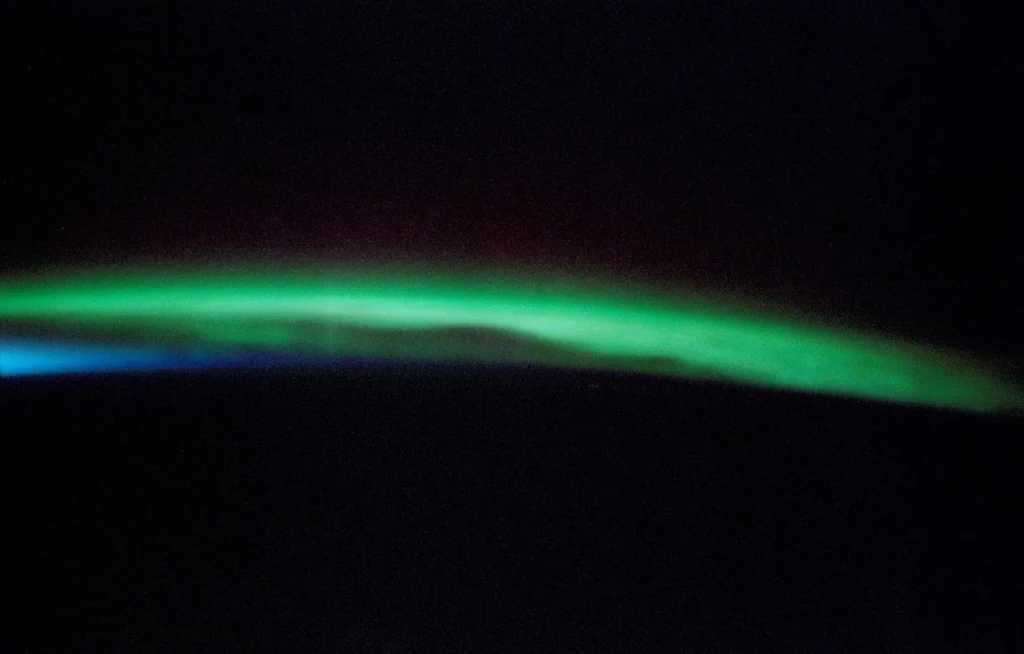
ISS006-327-026 (March 2003). The Aurora Borealis, also known as "northern lights", is featured in this photograph taken by astronaut Donald R. Pettit, Expedition 6 NASA ISS science officer, onboard the International Space Station.
NASA · JSC · 2003-03-01 · Aurora on Wikipedia
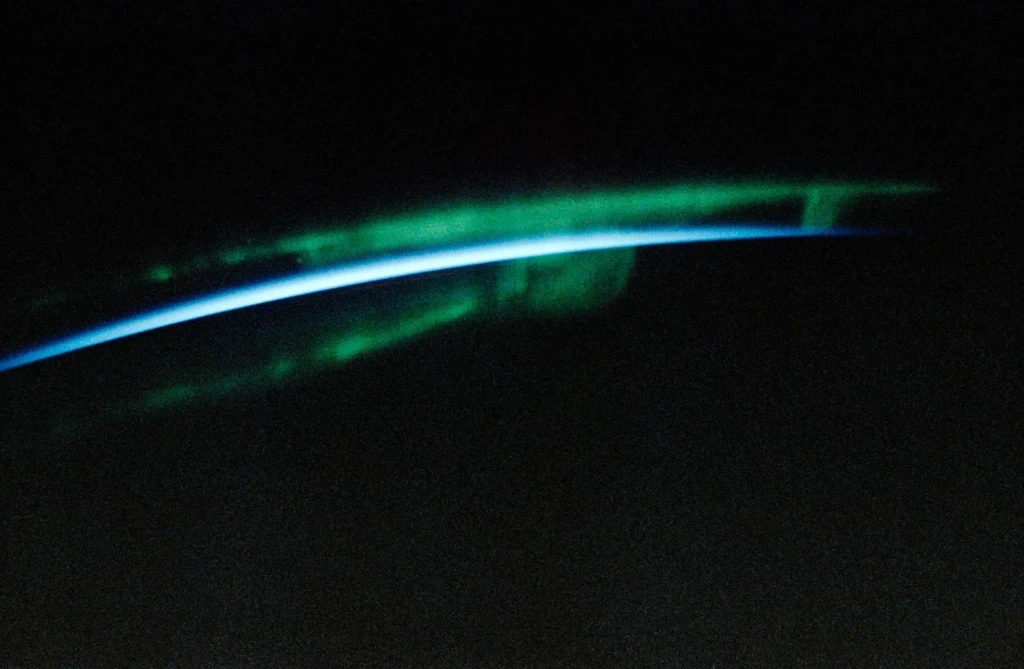
STS-45 Earth observation taken onboard Atlantis, Orbiter Vehicle (OV) 104, is of the Aurora Australis or Southern Lights. The green appearing auroral activity engulfs the thin blue line on the Earth's limb.
Aurorae were observed and photographed throughout the STS-45 nine-day mission.
NASA · JSC · 1992-04-02 · Aurora on Wikipedia
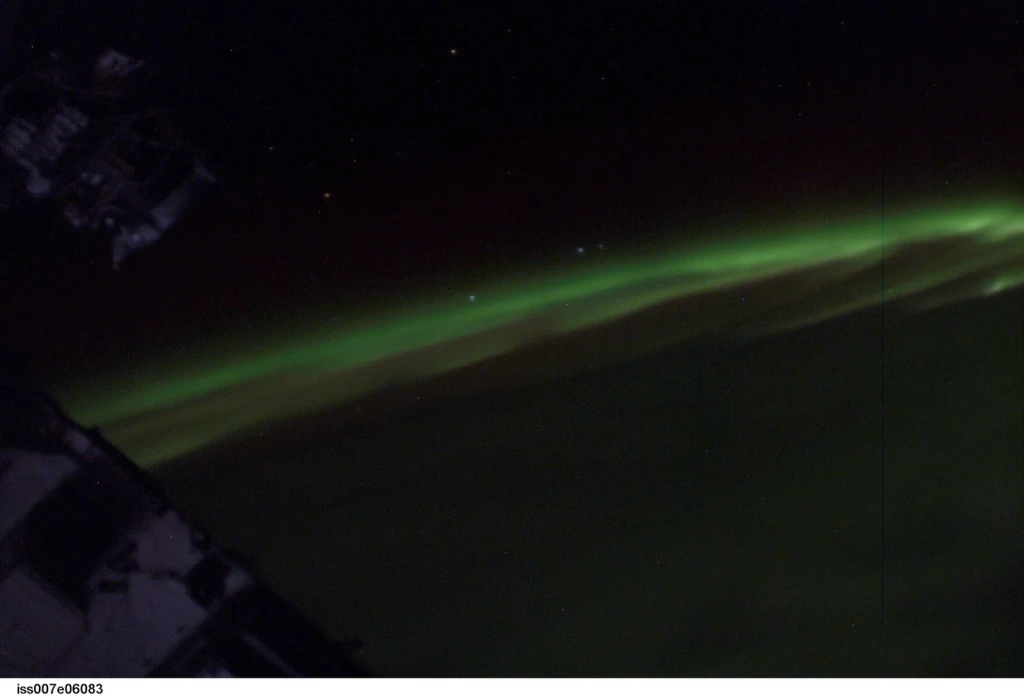
ISS007-E-06083 (3 June 2003) --- This view featuring the Aurora Australis or “southern lights” was photographed by astronaut Edward T. Lu, Expedition 7 NASA ISS science officer and flight engineer aboard the International Space Station (ISS). The four stars hanging above Earth’s limb are the brightest stars of the southern constellation Corvus.
NASA · JSC · 2003-06-03 · Aurora on Wikipedia
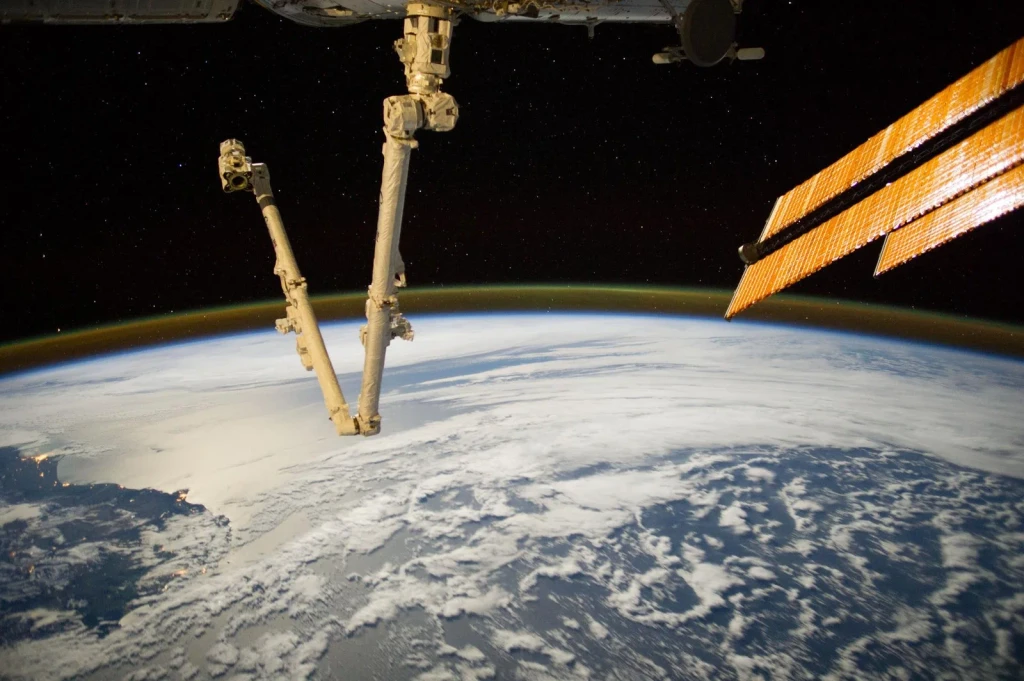
Earth Observation taken during a night pass by the Expedition 40 crew aboard the International Space Station.
The Space Station Remote Manipulator System arm is visible. Aurora visible over Earth limb.
NASA · JSC · 2014-07-14 · International Space Station on Wikipedia
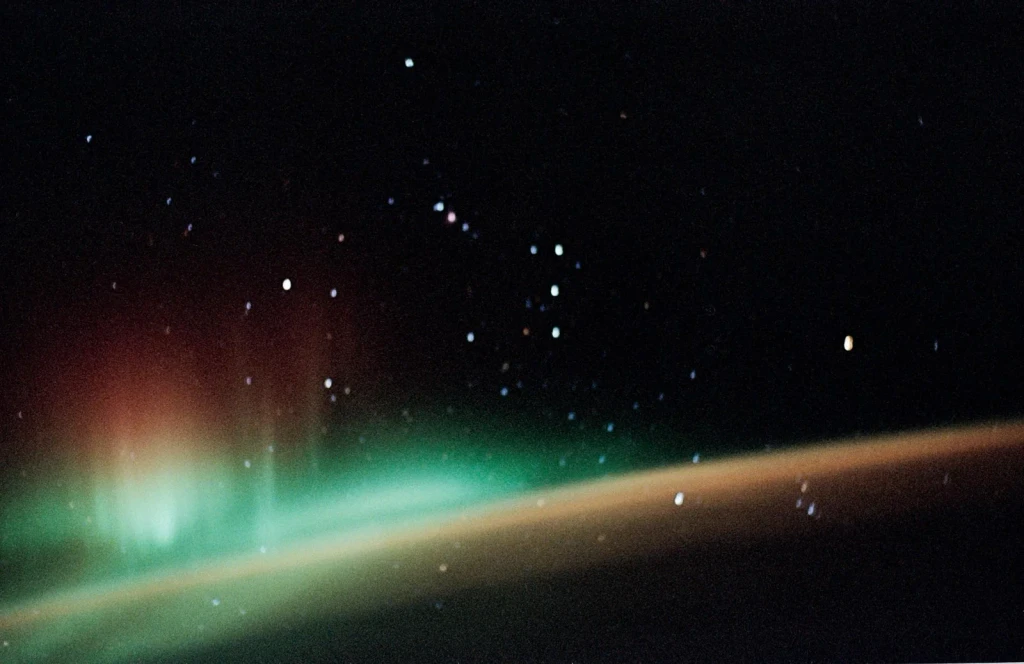
The constellation Orion is backdropped against a colorful display of the Southern Lights (aurora australis) in this 35mm image. Six NASA astronauts went on to spend a week and a half aboard the Space Shuttle Endeavour in support of the Space Radar Laboratory (SRL-1) mission.
(STS059-52-029, 9, 20 April 1994)
NASA · JSC · 1994-04-10 · Aurora on Wikipedia
