3D Gallery
The Cosmos
Enter gallery
The Cosmos is a 3D virtual gallery on MyGallery3D, a walkable online exhibition of 28 works. Step inside and explore it in your browser: no app, no headset.
A 3D virtual museum of space. Walk through deep space as our telescopes and spacecraft have recorded it: nebulae where stars are still forming, spiral galaxies millions of light-years away, and the planets of our own solar system.
Every image in this online exhibition was made by NASA and is in the public domain. Each one carries the mission or observatory that captured it, the date, and a link back to NASA's archive.
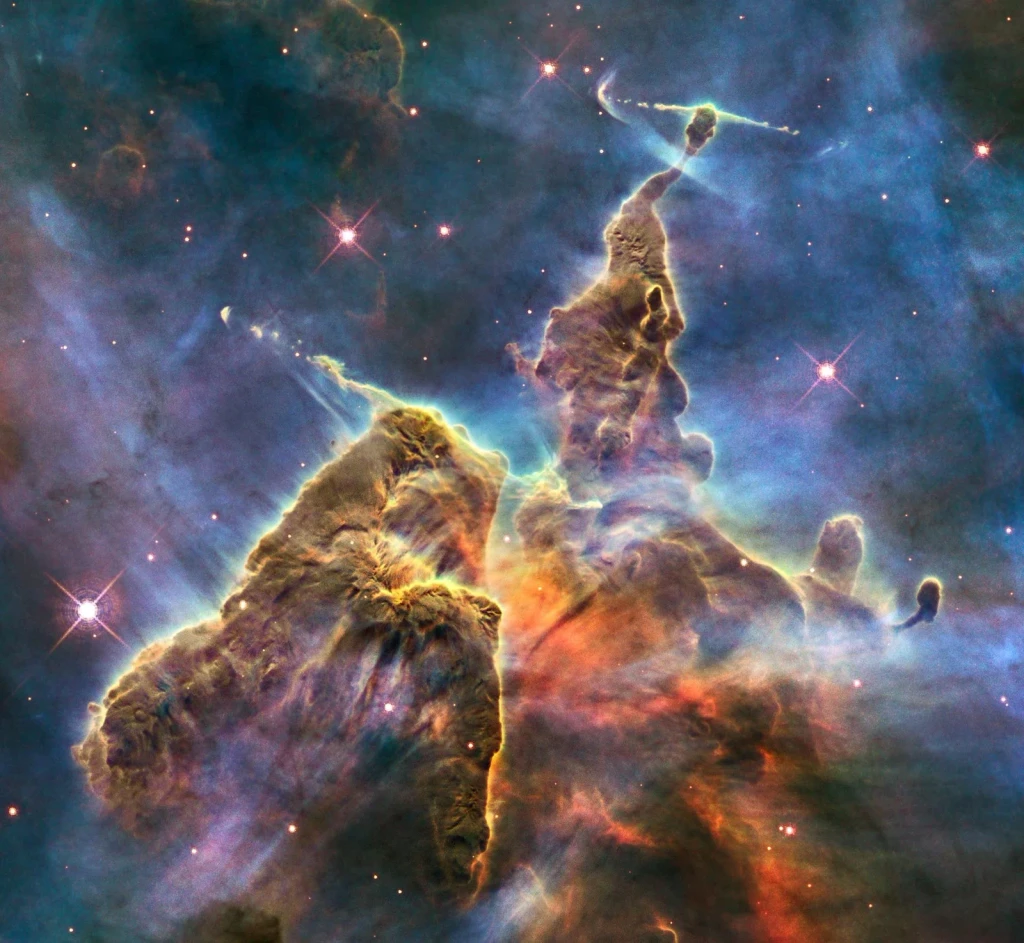
This brand new Hubble photo is of a small portion of one of the largest seen star-birth regions in the galaxy, the Carina Nebula. Towers of cool hydrogen laced with dust rise from the wall of the nebula. The scene is reminiscent of Hubble's classic "Pillars of Creation" photo from 1995, but is even more striking in appearance.
The image captures the top of a three-light-year-tall pillar of gas and dust that is being eaten away by the brilliant light from nearby bright stars. The pillar is also being pushed apart from within, as infant stars buried inside it fire off jets of gas that can be seen streaming from towering peaks like arrows sailing through the air.
NASA · GSFC · 2017-12-08 · Carina Nebula on Wikipedia
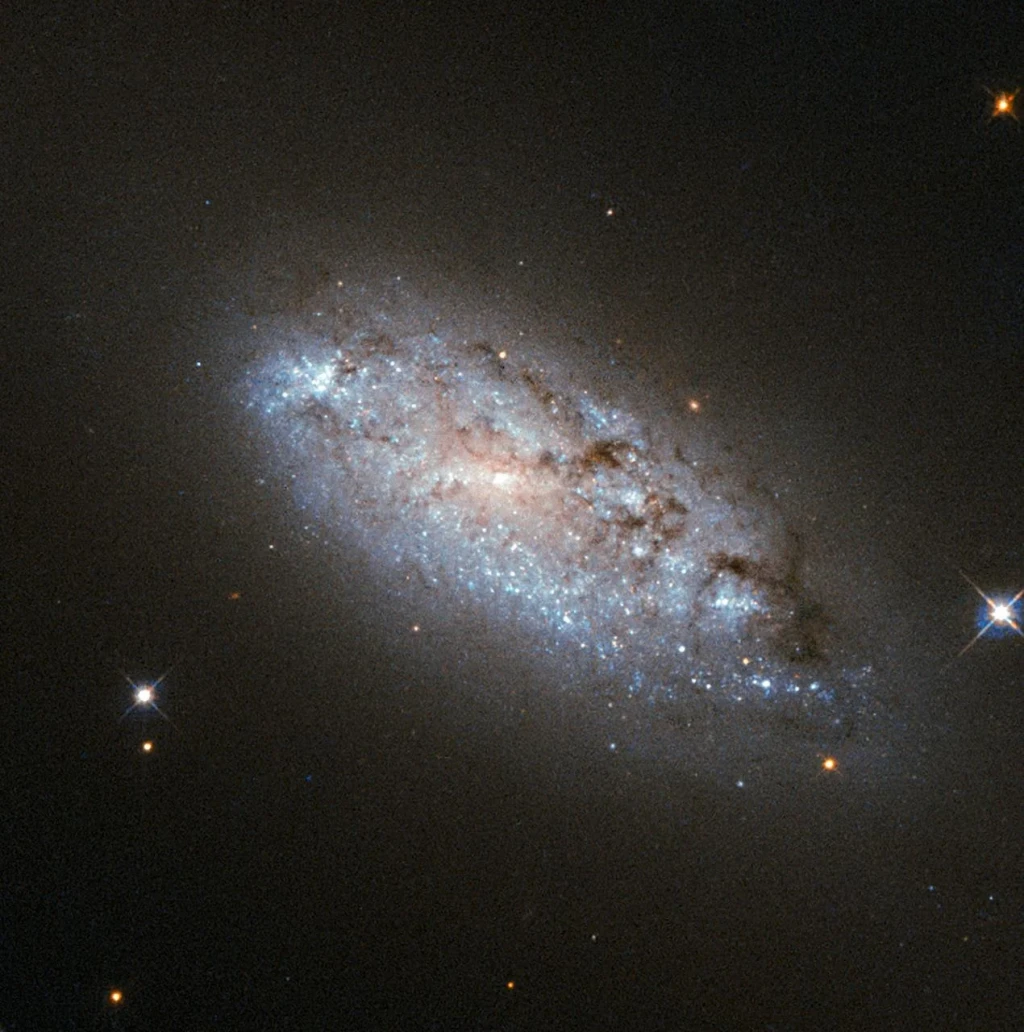
This image provides the clearest ever view of galaxy NGC 949, which lies over 30 million light-years away in the constellation of Triangulum. The galaxy has an unusual shape, made more obscure due to its inclination. From our point of view, it is difficult to discern exactly what type of galaxy NGC 949 is, but it is certainly a disk galaxy of some kind, most likely a spiral. NGC 949 was first discovered by Sir William Herschel on September 21, 1786, using an 18.7-inch reflecting telescope. The galaxy was one of about 3,000 objects Herschel cataloged as "nebulae" during an intense and systematic deep sky survey, the results of which eventually formed the bulk of the New General Catalogue (NGC). Taken with Hubble’s Advanced Camera for Surveys (ACS), this image shows extraordinary detail. This detail allows us to see a strange asymmetric alignment in the dark lanes of dust that snake across the galaxy. The top-right half of the galaxy appears considerably more marbled with dust in this image; a curious observation explained by stars tending to favor locations towards the center of a galaxy, and dust preferring almost invariably to reside along the galactic plane. When a galaxy is inclined as NGC 949 is, some regions, in this case the top-right, are tipped toward us and the light from the stars we see in these regions has had to travel through more dust. This causes the light to appear redder, the result of the same process that gives the sun’s light a red hue at dusk, or else disappear entirely, making the dust appear more prominent on that side of the galaxy. In the part tipped away from us, the light from the stars has had to pass through much less dust to reach us, so it appears brighter, and the dust is much less prominent. Were it possible to view NGC 949 from the opposite side, the apparent alignment of the dust would be reversed. The scientific advantages of this effect were recently displayed in suitably stunning style in the M31 PHAT mosaic, which allowed astronomers to produce a partial three-dimensional dust map of M31 four times clearer than any previously attempted.
NASA · GSFC · 2017-12-08
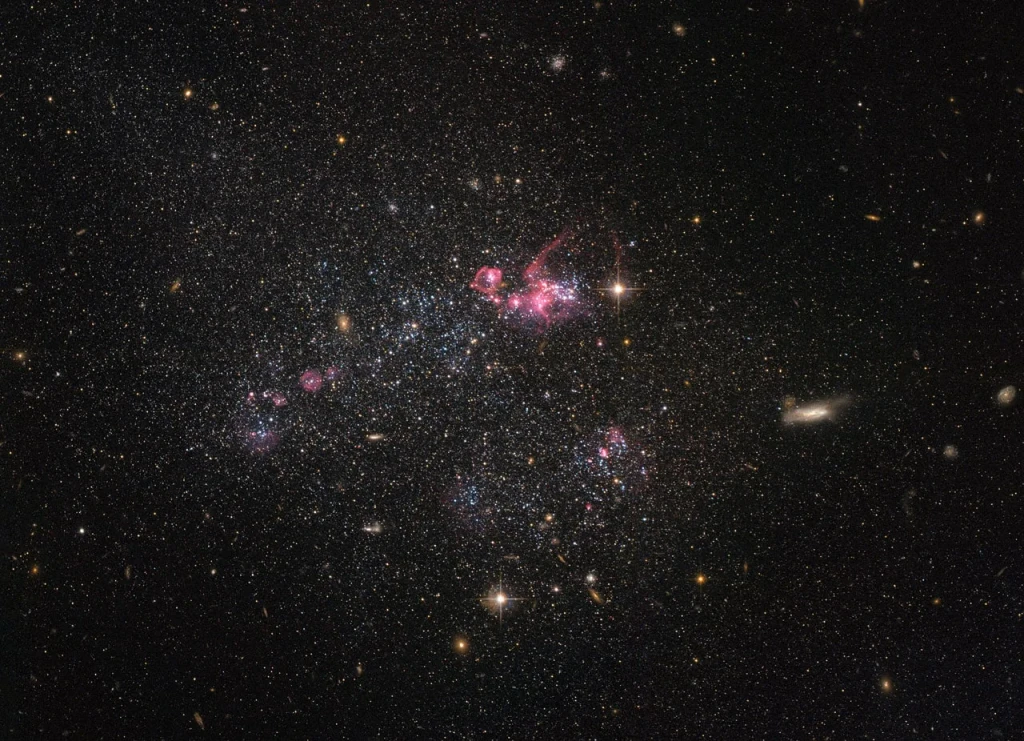
Despite being less famous than their elliptical and spiral galactic cousins, irregular dwarf galaxies, such as the one captured in this NASA/ESA Hubble Space Telescope image, are actually one of the most common types of galaxy in the Universe. Known as UGC 4459, this dwarf galaxy is located approximately 11 million light-years away in the constellation of Ursa Major (The Great Bear), a constellation that is also home to the Pinwheel Galaxy (M101), the Owl Nebula (M97), Messier 81, Messier 82 and several other galaxies all part of the M81 group.
UGC 4459's diffused and disorganised appearance is characteristic of an irregular dwarf galaxy. Lacking a distinctive structure or shape, irregular dwarf galaxies are often chaotic in appearance, with neither a nuclear bulge (a huge, tightly packed central group of stars) nor any trace of spiral arms (regions of stars extending from the centre of the galaxy). Astronomers suspect that some irregular dwarf galaxies were once spiral or elliptical galaxies, but were later deformed by the gravitational pull of nearby objects.
Rich with young blue stars and older red stars, UGC 4459 has a stellar population of several billion. Though seemingly impressive, this is small when compared to the 200 to 400 billion stars in the Milky Way. Observations with Hubble have shown that because of their low masses, star formation is very low compared to larger galaxies. Only very little of their original gas has been turned into stars. Thus, these small galaxies are interesting to study to better understand primordial environments and the star formation process.
NASA · GSFC · 2016-03-28
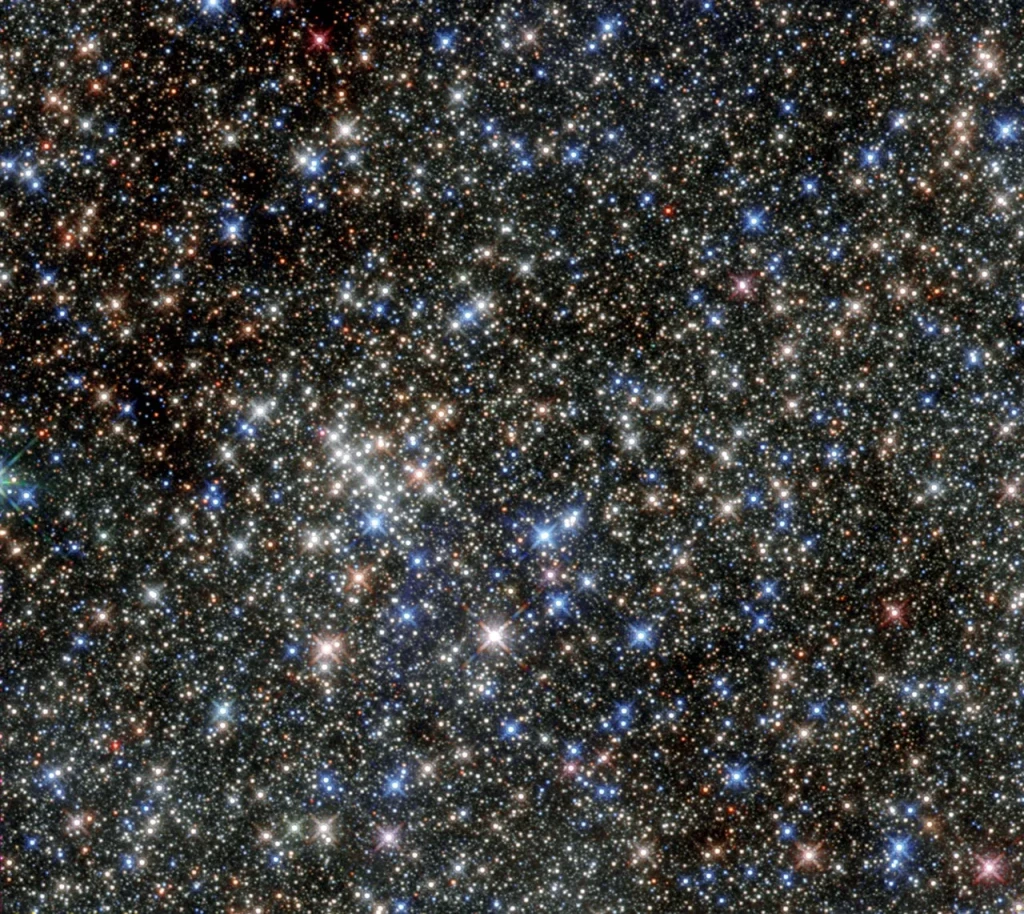
Although this cluster of stars gained its name due to its five brightest stars, it is home to hundreds more. The huge number of massive young stars in the cluster is clearly captured in this NASA/ESA Hubble Space Telescope image. The cluster is located close to the Arches Cluster and is just 100 light-years from the centre of our galaxy. The cluster's proximity to the dust at the centre of the galaxy means that much of its visible light is blocked, which helped to keep the cluster unknown until its discovery in 1990, when it was revealed by observations in the infrared. Infrared images of the cluster allow us to see through the obscuring dust to the hot stars in the cluster.
The Quintuplet Cluster hosts two extremely rare luminous blue variable stars: the Pistol Star and the lesser known V4650 Sgr. If you were to draw a line horizontally through the centre of this image from left to right, you could see the Pistol Star hovering just above the line about one third of the way along it. The Pistol Star is one of the most luminous known stars in the Milky Way and takes its name from the shape of the Pistol Nebula that it illuminates, but which is not visible in this infrared image. The exact age and future of the Pistol Star are uncertain, but it is expected to end in a supernova or even a hypernova in one to three million years.
The cluster also contains a number of red supergiants. These stars are among the largest in the galaxy and are burning their fuel at an incredible speed, meaning they will have a very short lifetime. Their presence suggests an average cluster age of nearly four million years. At the moment these stars are on the verge of exploding as supernovae. During their spectacular deaths they will release vast amounts of energy which, in turn, will heat the material, dust and gas, between the other stars.
NASA · GSFC · 2015-07-13 · Quintuplet Cluster on Wikipedia
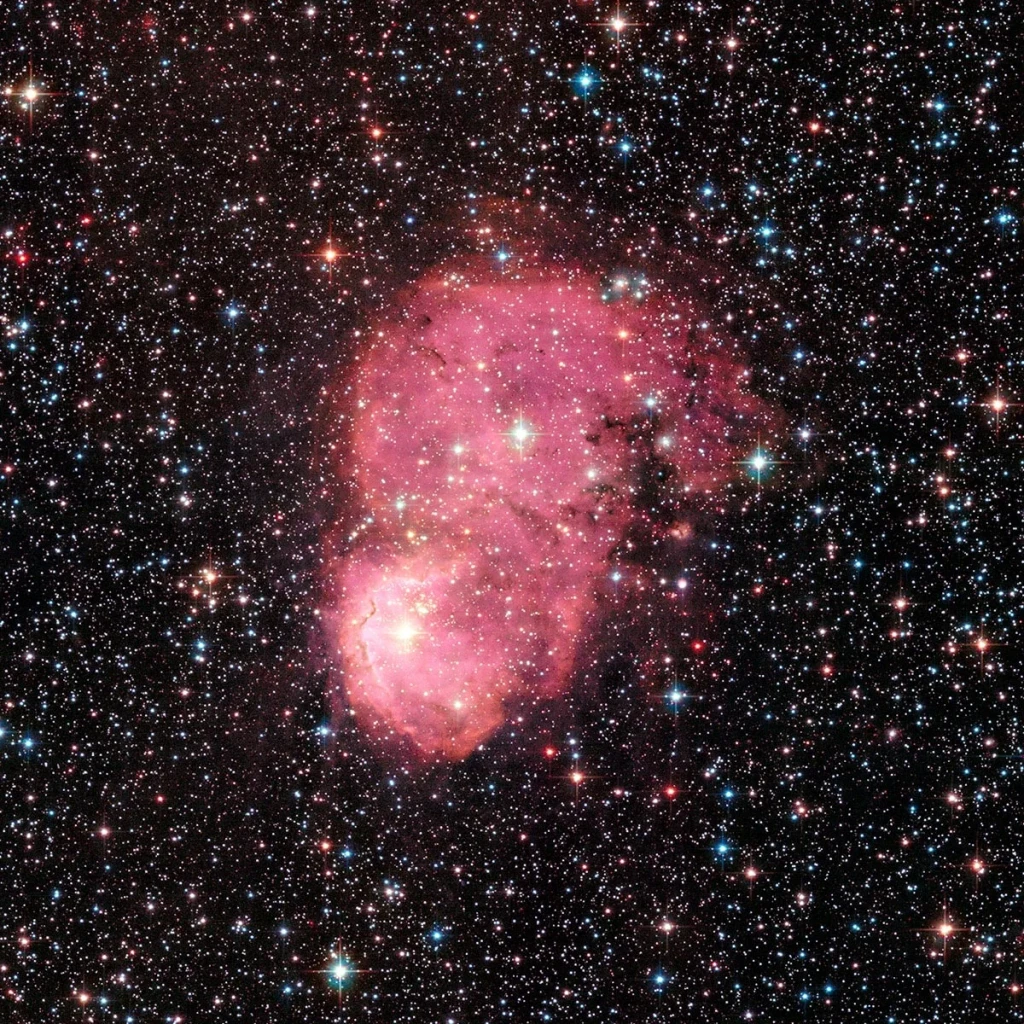
NASA's Hubble Space Telescope captured two festive-looking nebulas, situated so as to appear as one. They reside in the Small Magellanic Cloud, a dwarf galaxy that is a satellite of our Milky Way galaxy. Intense radiation from the brilliant central stars is heating hydrogen in each of the nebulas, causing them to glow red. The nebulas, together, are called NGC 248. They were discovered in 1834 by the astronomer Sir John Herschel. NGC 248 is about 60 light-years long and 20 light-years wide. It is among a number of glowing hydrogen nebulas in the dwarf satellite galaxy, which is located approximately 200,000 light-years away in the southern constellation Tucana.
The image is part of a study called Small Magellanic Cloud Investigation of Dust and Gas Evolution (SMIDGE). Astronomers are using Hubble to probe the Milky Way satellite to understand how dust is different in galaxies that have a far lower supply of heavy elements needed to create dust. The Small Magellanic Cloud has between a fifth and a tenth of the amount of heavy elements that the Milky Way does. Because it is so close, astronomers can study its dust in great detail, and learn about what dust was like earlier in the history of the universe.
Dust is a really critical part of how a galaxy works, how it forms stars. Most of the star formation happened earlier in the universe, at a time where there was a much lower percentage of heavy elements than there is now.
NASA · GSFC · 2017-12-08 · NGC 248 on Wikipedia
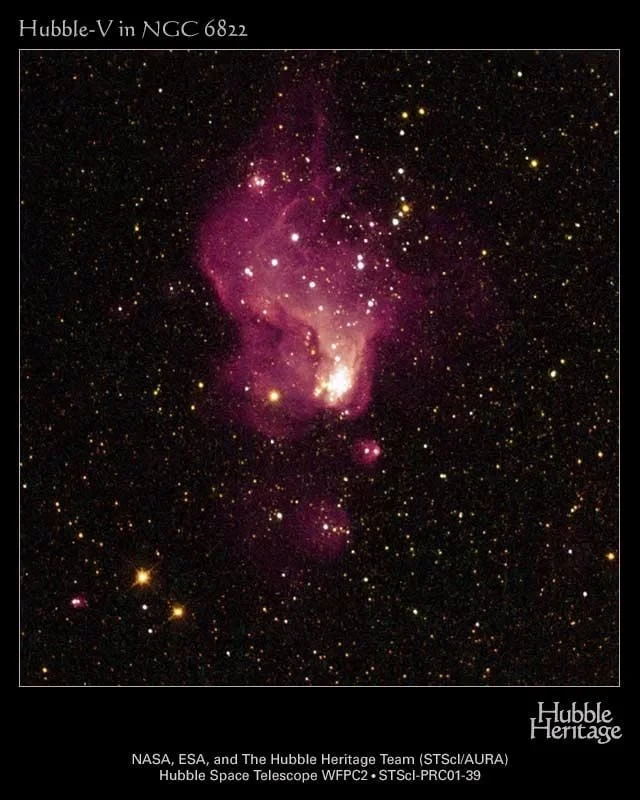
Resembling curling flames from a campfire, a magnificent nebula in a nearby galaxy observed by NASA Hubble Space Telescope provides new insight into the fierce birth of stars as it may have occurred in the early universe.
NASA · JPL · 1999-12-10
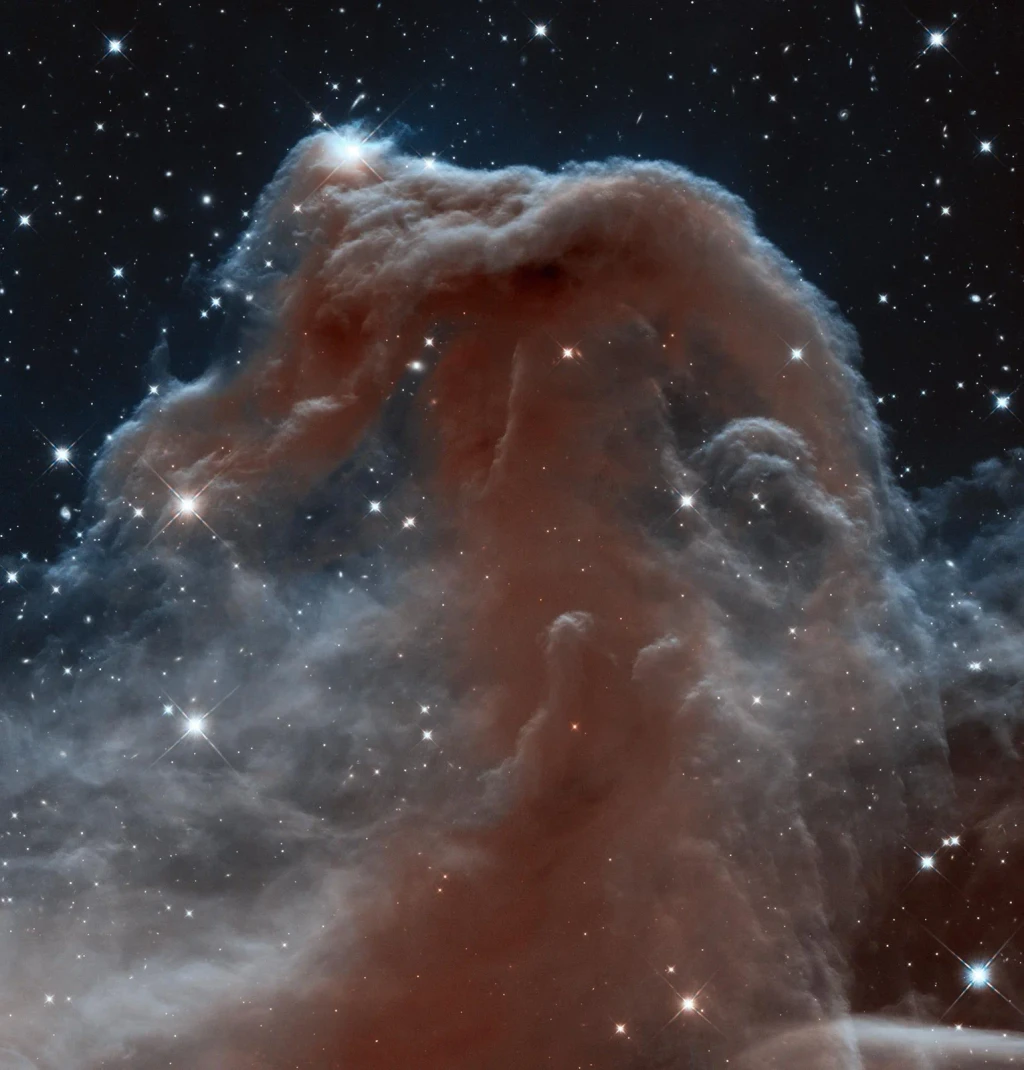
Astronomers have used NASA's Hubble Space Telescope to photograph the iconic Horsehead Nebula in infrared light to mark the 23rd anniversary of the famous observatory's launch aboard the space shuttle Discovery on April 24, 1990.
Looking like an apparition rising from whitecaps of interstellar foam, the iconic Horsehead Nebula has graced astronomy books ever since its discovery more than a century ago. The nebula is a favorite target for amateur and professional astronomers. It is shadowy in optical light. It appears transparent and ethereal when seen at infrared wavelengths. The rich tapestry of the Horsehead Nebula pops out against the backdrop of Milky Way stars and distant galaxies that easily are visible in infrared light.
NASA · GSFC · 2017-12-08 · Horsehead Nebula on Wikipedia
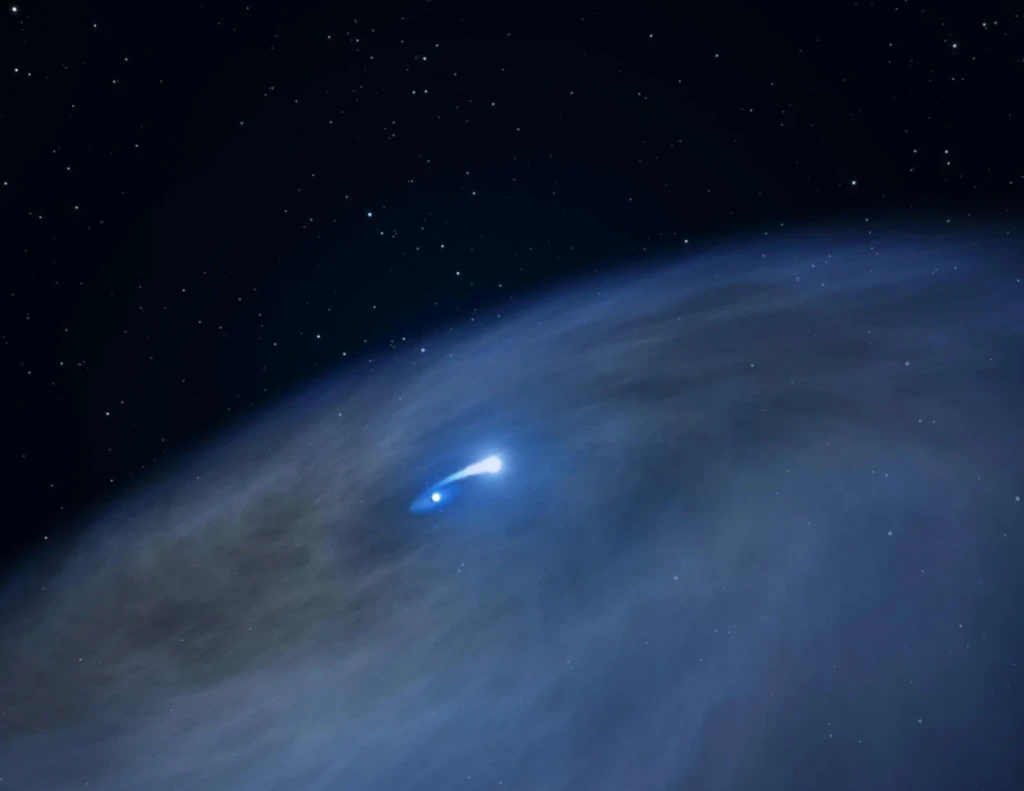
Astronomers using NASA’s Hubble Space Telescope have uncovered surprising new clues about a hefty, rapidly aging star whose behavior has never been seen before in our Milky Way galaxy. In fact, the star is so weird that astronomers have nicknamed it “Nasty 1,” a play on its catalog name of NaSt1. The star may represent a brief transitory stage in the evolution of extremely massive stars. First discovered several decades ago, Nasty 1 was identified as a Wolf-Rayet star, a rapidly evolving star that is much more massive than our sun. The star loses its hydrogen-filled outer layers quickly, exposing its super-hot and extremely bright helium-burning core. But Nasty 1 doesn’t look like a typical Wolf-Rayet star. The astronomers using Hubble had expected to see twin lobes of gas flowing from opposite sides of the star, perhaps similar to those emanating from the massive star Eta Carinae, which is a Wolf-Rayet candidate. Instead, Hubble revealed a pancake-shaped disk of gas encircling the star. The vast disk is nearly 2 trillion miles wide, and may have formed from an unseen companion star that snacked on the outer envelope of the newly formed Wolf-Rayet. Based on current estimates, the nebula surrounding the stars is just a few thousand years old, and as close as 3,000 light-years from Earth. Credits: NASA/Hubble
NASA · GSFC · 2015-03-21
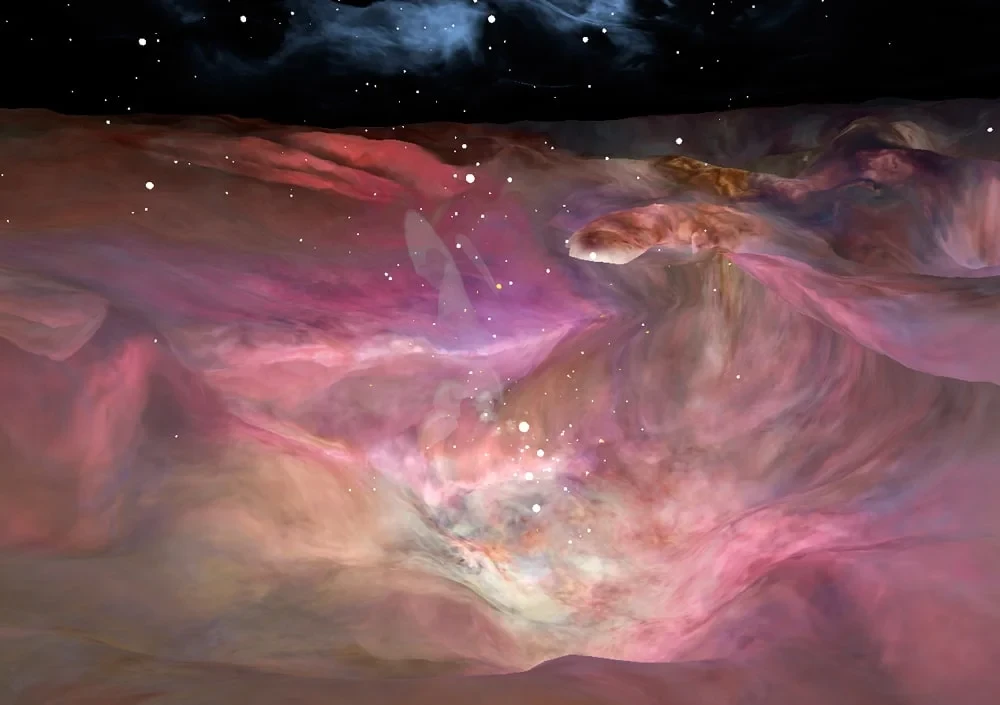
This image depicts a vast canyon of dust and gas in the Orion Nebula from a 3-D computer model based on observations by NASA's Hubble Space Telescope and created by science visualization specialists at the Space Telescope Science Institute (STScI) in Baltimore, Md. A 3-D visualization of this model takes viewers on an amazing four-minute voyage through the 15-light-year-wide canyon.
NASA · GSFC · 2017-12-08 · Orion Nebula on Wikipedia
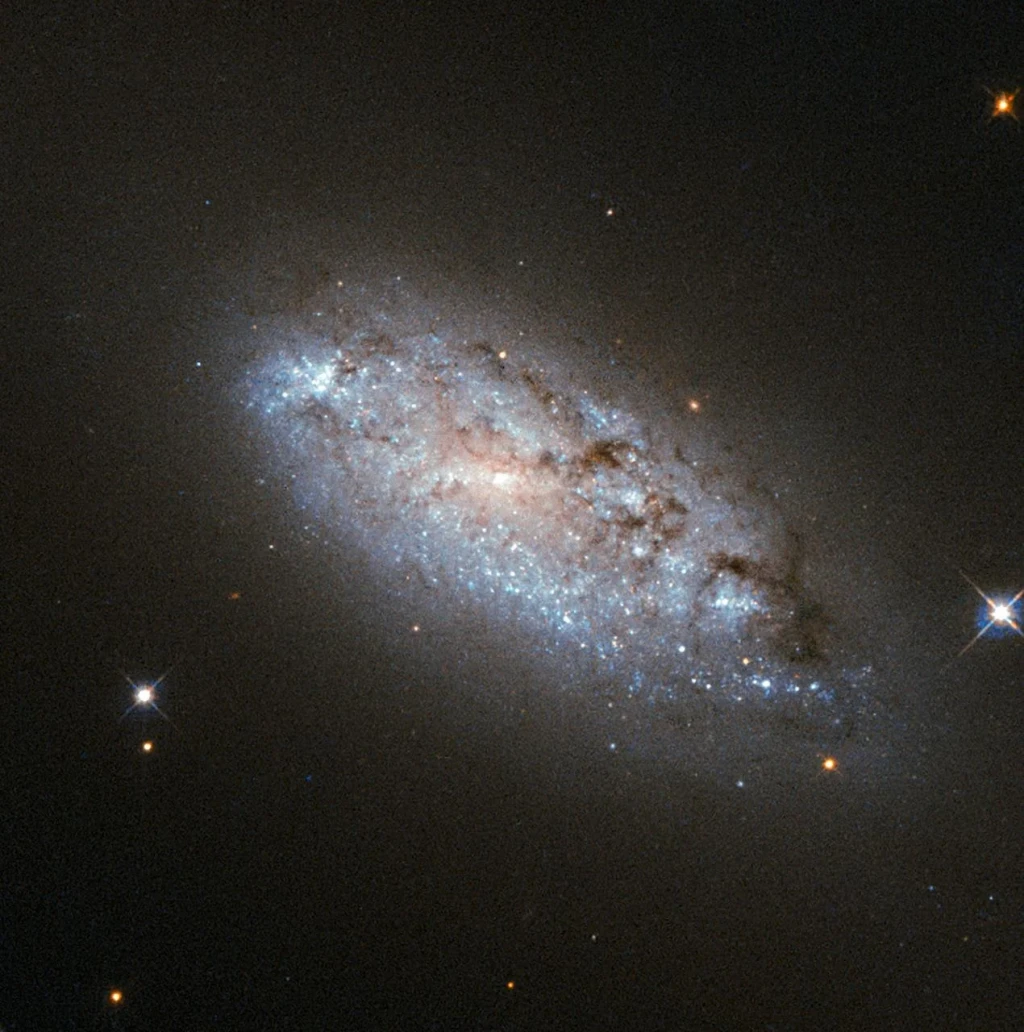
This image provides the clearest ever view of galaxy NGC 949, which lies over 30 million light-years away in the constellation of Triangulum. The galaxy has an unusual shape, made more obscure due to its inclination. From our point of view, it is difficult to discern exactly what type of galaxy NGC 949 is, but it is certainly a disc galaxy of some kind, most likely a spiral. NGC 949 was first discovered by Sir William Herschel on 21 September 1786, using an 18.7-inch reflecting telescope. The galaxy was one of about 3000 objects Herschel catalogued as "nebulae" during an intense and systematic deep sky survey, the results of which eventually formed the bulk of the New General Catalogue (NGC). Taken with Hubble’s Advanced Camera for Surveys (ACS), this new image shows extraordinary detail. This detail allows us to see a strange asymmetric alignment in the dark lanes of dust that snake across the galaxy. The top-right half of the galaxy appears considerably more marbled with dust in this image; a curious observation explained by stars tending to favour locations towards the centre of a galaxy, and dust preferring almost invariably to reside along the galactic plane. When a galaxy is inclined as NGC 949 is, some regions, in this case the top-right, are tipped towards us and the light from the stars we see in these regions has had to travel through more dust. This causes the light to appear redder, the result of the same process that gives the sun’s light a red hue at dusk, or else disappear entirely, making the dust appear more prominent on that side of the galaxy. In the part tipped away from us, the light from the stars has had to pass through much less dust to reach us, so it appears brighter, and the dust is much less prominent. Were it possible to view NGC 949 from the opposite side, the apparent alignment of the dust would be reversed. The scientific advantages of this effect were recently displayed in suitably stunning style in the M31 PHAT mosa
NASA · GSFC · 2015-05-04
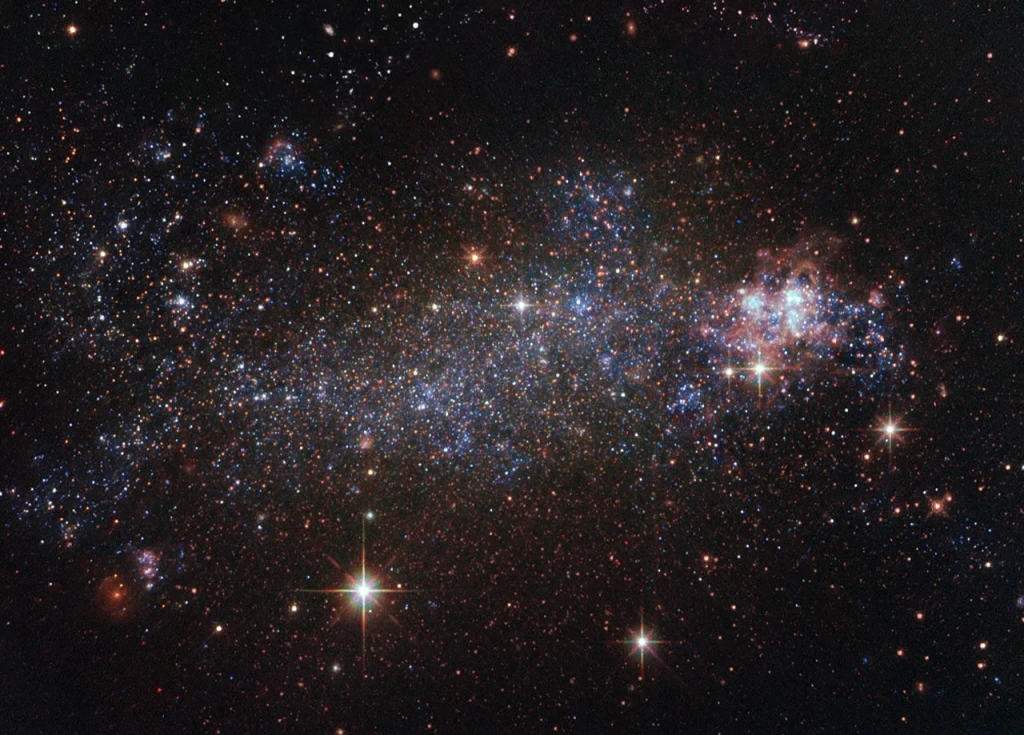
Most galaxies possess a majestic spiral or elliptical structure. About a quarter of galaxies, though, defy such conventional, rounded aesthetics, instead sporting a messy, indefinable shape. Known as irregular galaxies, this group includes NGC 5408, the galaxy that has been snapped here by the NASA/ESA Hubble Space Telescope.
John Herschel recorded the existence of NGC 5408 in June 1834. Astronomers had long mistaken NGC 5408 for a planetary nebula, an expelled cloud of material from an aging star. Instead, bucking labels, NGC 5408 turned out to be an entire galaxy, located about 16 million light-years from Earth in the constellation of Centaurus (The Centaur).
In yet another sign of NGC 5408 breaking convention, the galaxy is associated with an object known as an ultraluminous X-ray source, dubbed NGC 5408 X-1, one of the best studied of its class. These rare objects beam out prodigious amounts of energetic X-rays. Astrophysicists believe these sources to be strong candidates for intermediate-mass black holes. This hypothetical type of black hole has significantly less mass than the supermassive black holes found in galactic centers, which can have billions of times the mass of the sun, but have a good deal more mass than the black holes formed when giant stars collapse.
NASA · GSFC · 2017-12-08 · NGC 5408 on Wikipedia
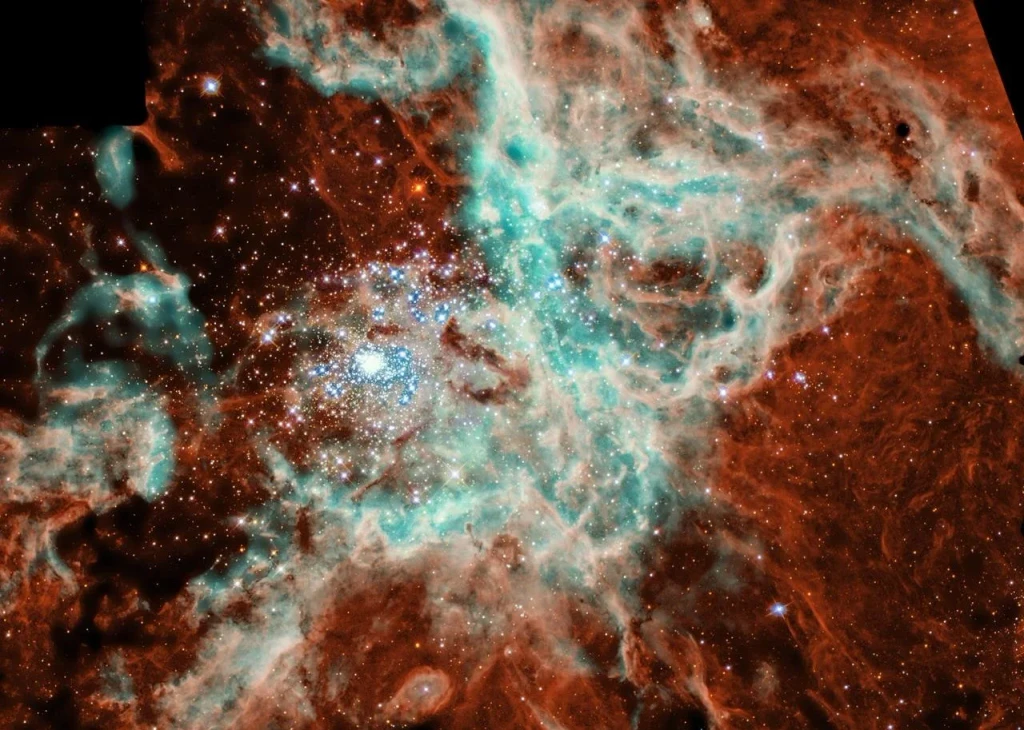
A panoramic view of a vast, sculpted area of gas and dust where thousands of stars are being born has been captured by NASA's Hubble Space Telescope. The image, taken by Hubble's Wide Field and Planetary Camera 2, offers an unprecedented, detailed view of the entire inner region of the fertile, star-forming 30 Doradus Nebula. The mosaic picture shows that ultraviolet radiation and high-speed material unleashed by the stars in the cluster, called R136 (the large blue blob left of center), are weaving a tapestry of creation and destruction, triggering the collapse of looming gas and dust clouds and forming pillar-like structures that incubate newborn stars.
The 30 Doradus Nebula is in the Large Magellanic Cloud, a satellite galaxy of the Milky Way located 170,000 light-years from Earth. Nebulas like 30 Doradus are signposts of recent star birth. High-energy ultraviolet radiation from young, hot, massive stars in R136 causes surrounding gaseous material to glow. Previous Hubble telescope observations showed that R136 contains several dozen of the most massive stars known, each about 100 times the mass of the Sun and about 10 times as hot. These stellar behemoths formed about 2 million years ago.
The stars in R136 produce intense "stellar winds," streams of material traveling at several million miles an hour. These winds push the gas away from the cluster and compress the inner regions of the surrounding gas and dust clouds, seen in the image as the pinkish material. The intense pressure triggers the collapse of parts of the clouds, producing a new star formation around the central cluster. Most stars in the nursery are not visible because they are still encased in cocoons of gas and dust.
This mosaic image of 30 Doradus consists of five overlapping pictures taken between January 1994 and September 2000 by the Wide Field and Planetary Camera 2. Several color filters enhance important details in the stars and the nebula. Blue corresponds to the hot stars. The greenish color denotes hot gas energized by the central cluster of stars. Pink depicts the glowing edges of the gas and dust clouds facing the cluster, which are being bombarded by winds and radiation. Reddish-brown represents the cooler surfaces of the clouds, which are not receiving direct radiation from the central cluster.
NASA · Select · 1999-12-01 · Tarantula Nebula on Wikipedia
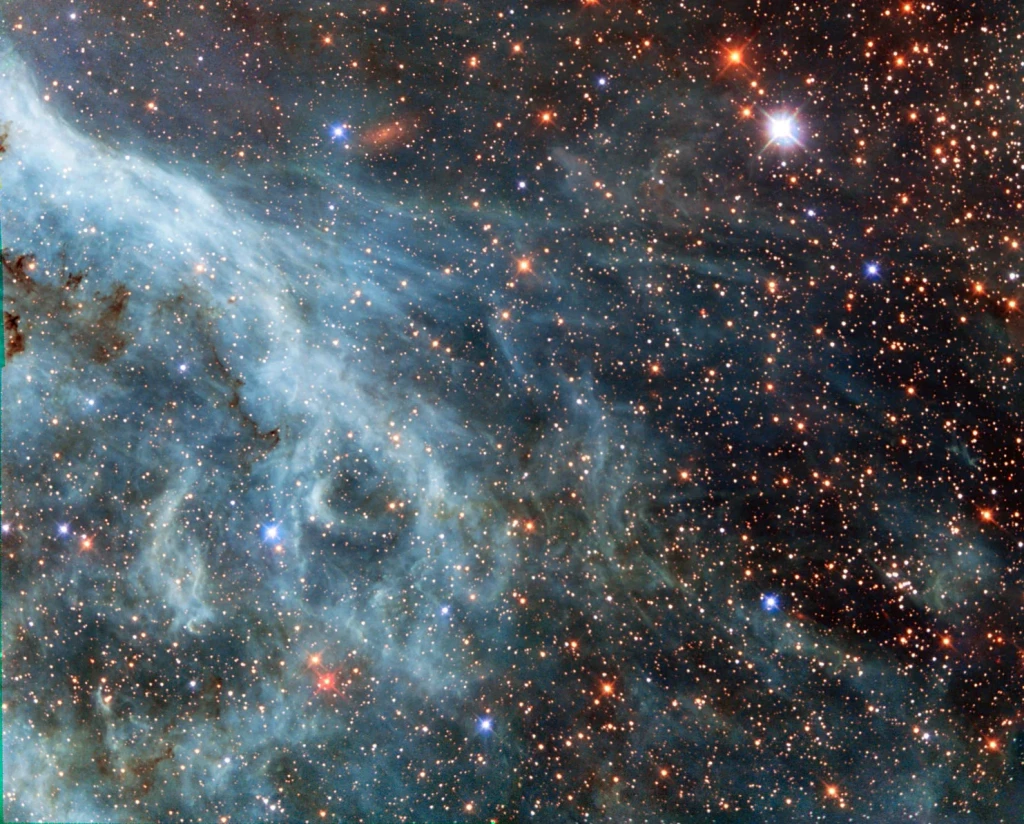
The brightly glowing plumes seen in this image are reminiscent of an underwater scene, with turquoise-tinted currents and nebulous strands reaching out into the surroundings. However, this is no ocean. This image actually shows part of the Large Magellanic Cloud (LMC), a small nearby galaxy that orbits our galaxy, the Milky Way, and appears as a blurred blob in our skies. The NASA/European Space Agency (ESA) Hubble Space Telescope has peeked many times into this galaxy, releasing stunning images of the whirling clouds of gas and sparkling stars (opo9944a, heic1301, potw1408a). This image shows part of the Tarantula Nebula's outskirts. This famously beautiful nebula, located within the LMC, is a frequent target for Hubble (heic1206, heic1402). In most images of the LMC the color is completely different to that seen here. This is because, in this new image, a different set of filters was used. The customary R filter, which selects the red light, was replaced by a filter letting through the near-infrared light. In traditional images, the hydrogen gas appears pink because it shines most brightly in the red. Here however, other less prominent emission lines dominate in the blue and green filters. This data is part of the Archival Pure Parallel Project (APPP), a project that gathered together and processed over 1,000 images taken using Hubble’s Wide Field Planetary Camera 2, obtained in parallel with other Hubble instruments. Much of the data in the project could be used to study a wide range of astronomical topics, including gravitational lensing and cosmic shear, exploring distant star-forming galaxies, supplementing observations in other wavelength ranges with optical data, and examining star populations from stellar heavyweights all the way down to solar-mass stars.
NASA · GSFC · 2017-12-08 · Large Magellanic Cloud on Wikipedia
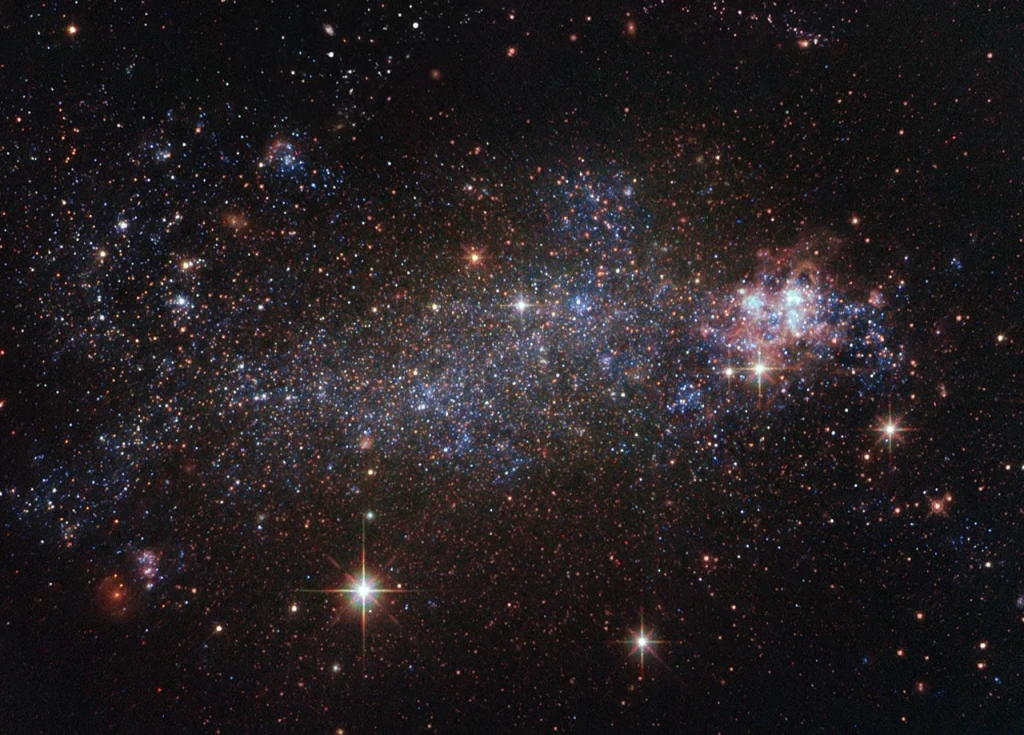
Most galaxies possess a majestic spiral or elliptical structure. About a quarter of galaxies, though, defy such conventional, rounded aesthetics, instead sporting a messy, indefinable shape. Known as irregular galaxies, this group includes NGC 5408, the galaxy that has been snapped here by the NASA/ESA Hubble Space Telescope.
English polymath John Herschel recorded the existence of NGC 5408 in June 1834. Astronomers had long mistaken NGC 5408 for a planetary nebula, an expelled cloud of material from an aging star. Instead, bucking labels, NGC 5408 turned out to be an entire galaxy, located about 16 million light-years from Earth in the constellation of Centaurus (The Centaur).
In yet another sign of NGC 5408 breaking convention, the galaxy is associated with an object known as an ultraluminous X-ray source, dubbed NGC 5408 X-1, one of the best studied of its class. These rare objects beam out prodigious amounts of energetic X-rays. Astrophysicists believe these sources to be strong candidates for intermediate-mass black holes. This hypothetical type of black hole has significantly less mass than the supermassive black holes found in galactic centres, which can have billions of times the mass of the Sun, but have a good deal more mass than the black holes formed when giant stars collapse.
NASA · GSFC · 2016-01-18 · NGC 5408 on Wikipedia
Some astronomical objects have endearing or quirky nicknames, inspired by mythology or their own appearance. Take, for example, the constellation of Orion (The Hunter), the Sombrero Galaxy, the Horsehead Nebula, or even the Milky Way. However, the vast majority of cosmic objects appear in astronomical catalogs and are given rather less poetic names based on the order of their discovery.
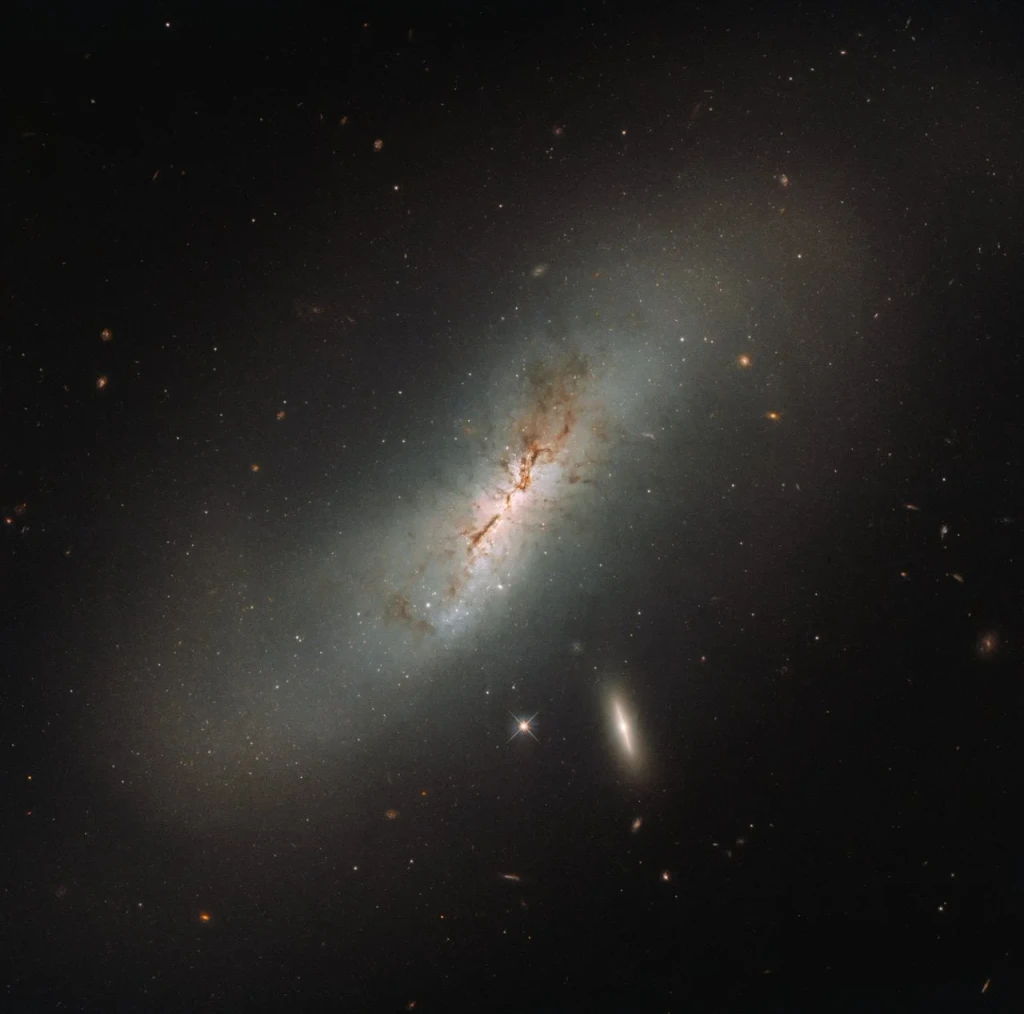
Two galaxies are clearly visible in this Hubble image, the larger of which is NGC 4424. This galaxy is cataloged in the New General Catalog of Nebulae and Clusters of Stars (NGC), which was compiled in 1888. The NGC is one of the largest astronomical catalogs, which is why so many Hubble Pictures of the Week feature NGC objects. In total there are 7,840 entries in the catalog and they are also generally the larger, brighter, and more eye-catching objects in the night sky, and hence the ones more easily spotted by early stargazers.
The smaller, flatter, bright galaxy sitting just below NGC 4424 is named LEDA 213994. The Lyon-Meudon Extragalactic Database (LEDA) is far more modern than the NGC and contains millions of objects. Many NGC objects still go by their initial names simply because they were christened within the NGC first. However, since astronomers can't resist a good acronym and "Leda" is more appealing than "the LMED," the smaller galaxy is called "Leda." Leda was a princess in Ancient Greek mythology.
NASA · GSFC · 2017-12-08 · NGC 4424 on Wikipedia
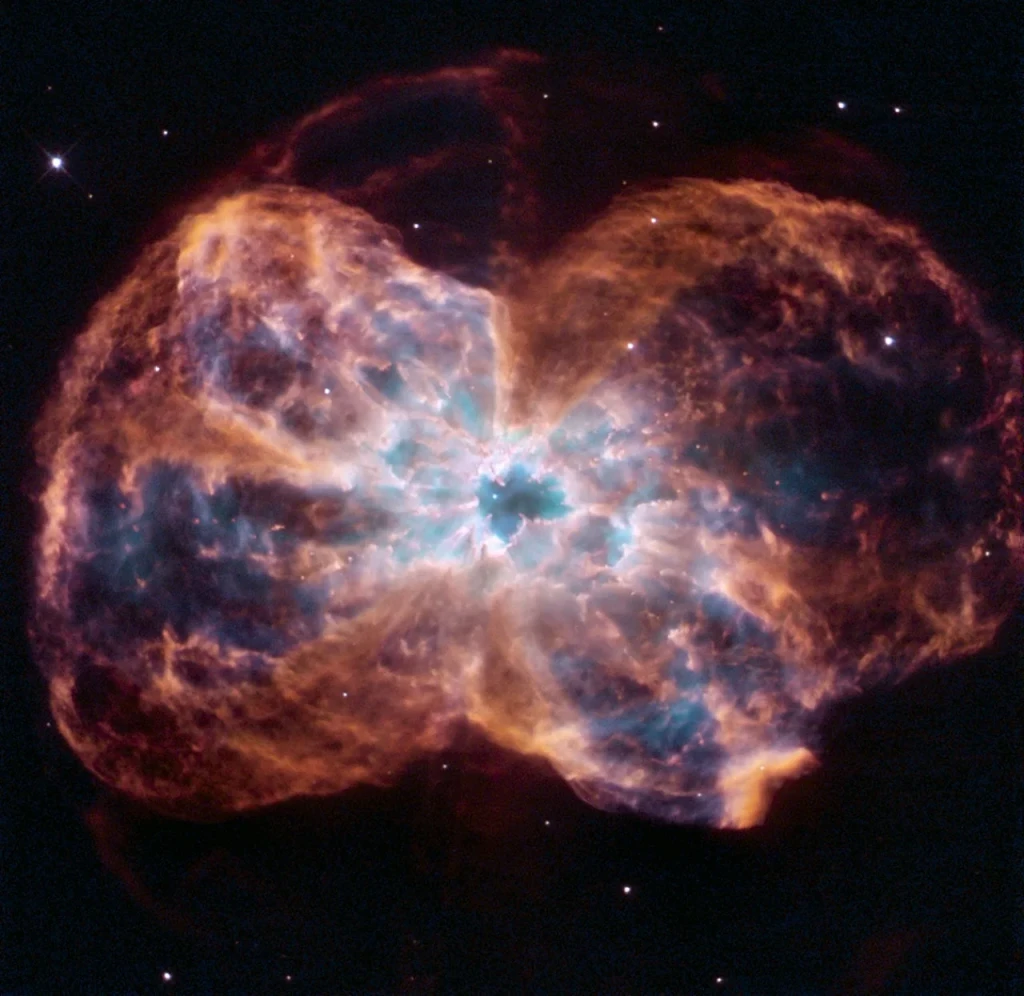
This image, taken by the NASA/ESA Hubble Space Telescope, shows the colorful "last hurrah" of a star like our sun. The star is ending its life by casting off its outer layers of gas, which formed a cocoon around the star's remaining core. Ultraviolet light from the dying star makes the material glow. The burned-out star, called a white dwarf, is the white dot in the center. Our sun will eventually burn out and shroud itself with stellar debris, but not for another 5 billion years. Our Milky Way Galaxy is littered with these stellar relics, called planetary nebulae. The objects have nothing to do with planets. Eighteenth- and nineteenth-century astronomers called them the name because through small telescopes they resembled the disks of the distant planets Uranus and Neptune.
The planetary nebula in this image is called NGC 2440. The white dwarf at the center of NGC 2440 is one of the hottest known, with a surface temperature of more than 360,000 degrees Fahrenheit (200,000 degrees Celsius). The nebula's chaotic structure suggests that the star shed its mass episodically. During each outburst, the star expelled material in a different direction. This can be seen in the two bowtie-shaped lobes. The nebula also is rich in clouds of dust, some of which form long, dark streaks pointing away from the star.
NGC 2440 lies about 4,000 light-years from Earth in the direction of the constellation Puppis. The material expelled by the star glows with different colors depending on its composition, its density and how close it is to the hot central star. Blue samples helium; blue-green oxygen, and red nitrogen and hydrogen.
NASA · GSFC · 2017-12-08 · NGC 2440 on Wikipedia
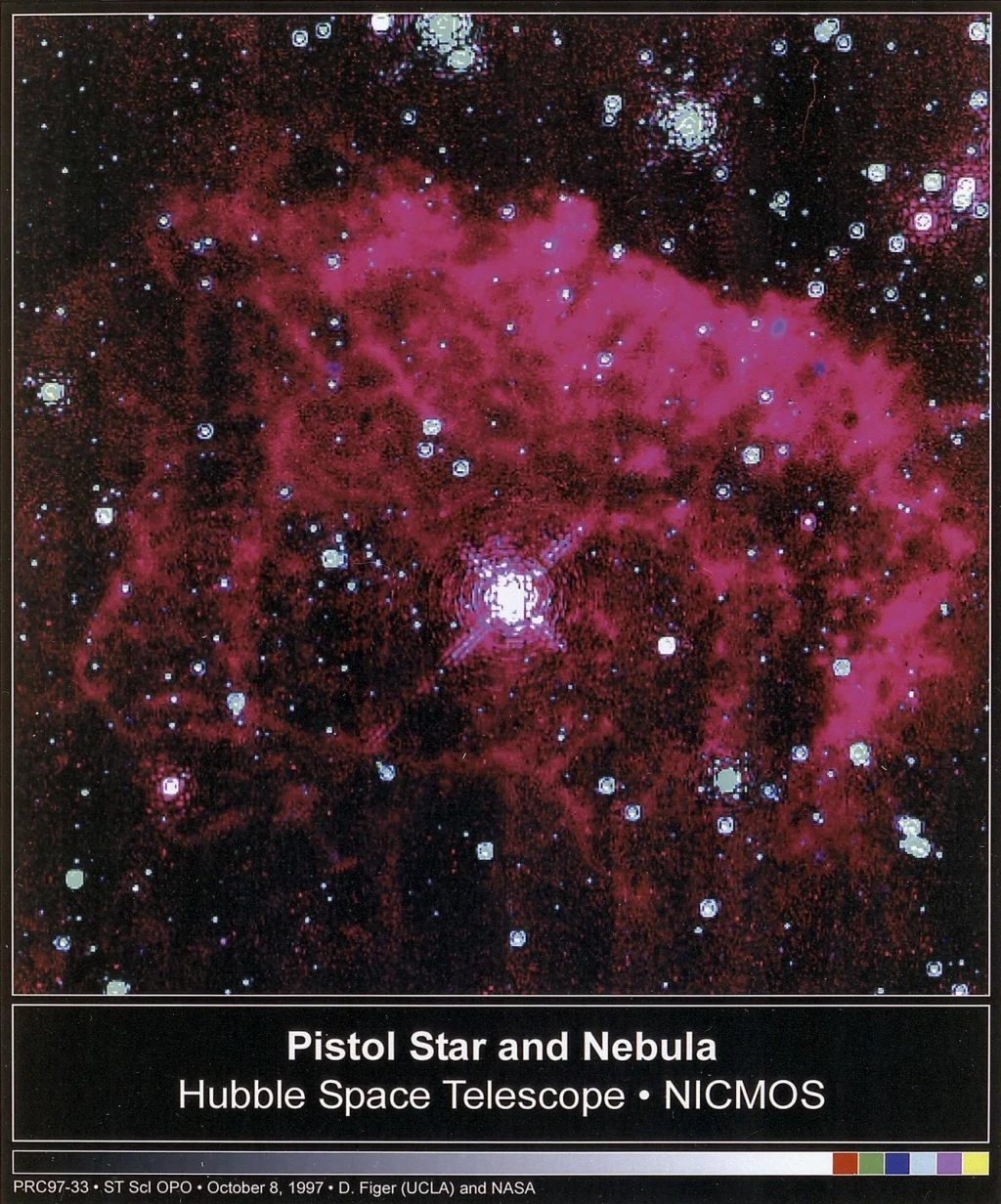
Astronomers using the Hubble Space Telescope (HST) have identified what may be the most luminous star known, a celestial mammoth that releases up to 10-million times the power of the Sun and is big enough to fill the diameter of Earth's orbit. The star unleashes as much energy in six seconds as our Sun does in one year.
The image, taken by a UCLA-led team with the recently installed Near-Infrared Camera and Multi-Object Spectrometer (NICMOS) aboard the HST, also reveals a bright nebula, created by extremely massive stellar eruptions. The UCLA astronomers estimate that the star, called the Pistol Star, is approximately 25,000 light-years from Earth, near the center of our Milky Way galaxy.
The Pistol Star is not visible to the eye, but is located in the direction of the constellation Sagittarius, hidden behind the great dust clouds along the Milky Way.
NASA · MSFC · 1997-01-01 · Pistol Star on Wikipedia
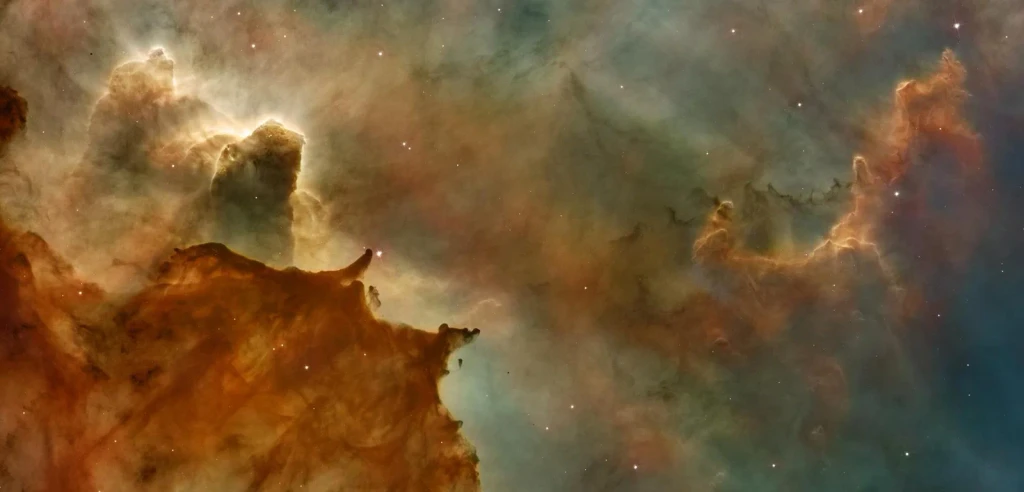
The Hubble Space Telescope captured this detailed view of the Carina Nebula, revealing the great clouds of gas and dust in this region of space.
NASA · GSFC · 2017-12-08 · Carina Nebula on Wikipedia
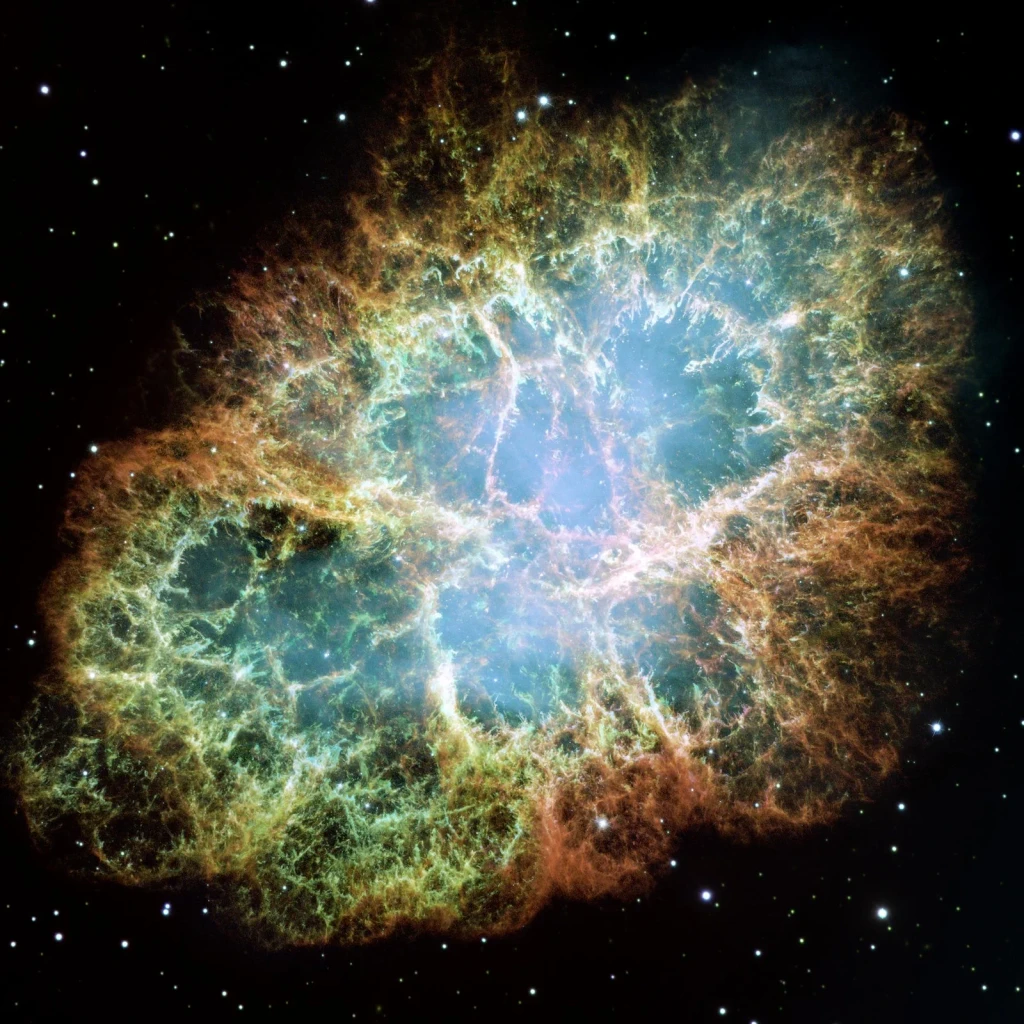
The Crab Nebula is a supernova remnant, all that remains of a tremendous stellar explosion. Observers in China and Japan recorded the supernova nearly 1,000 years ago, in 1054.
NASA · GSFC · 2017-12-08 · Crab Nebula on Wikipedia
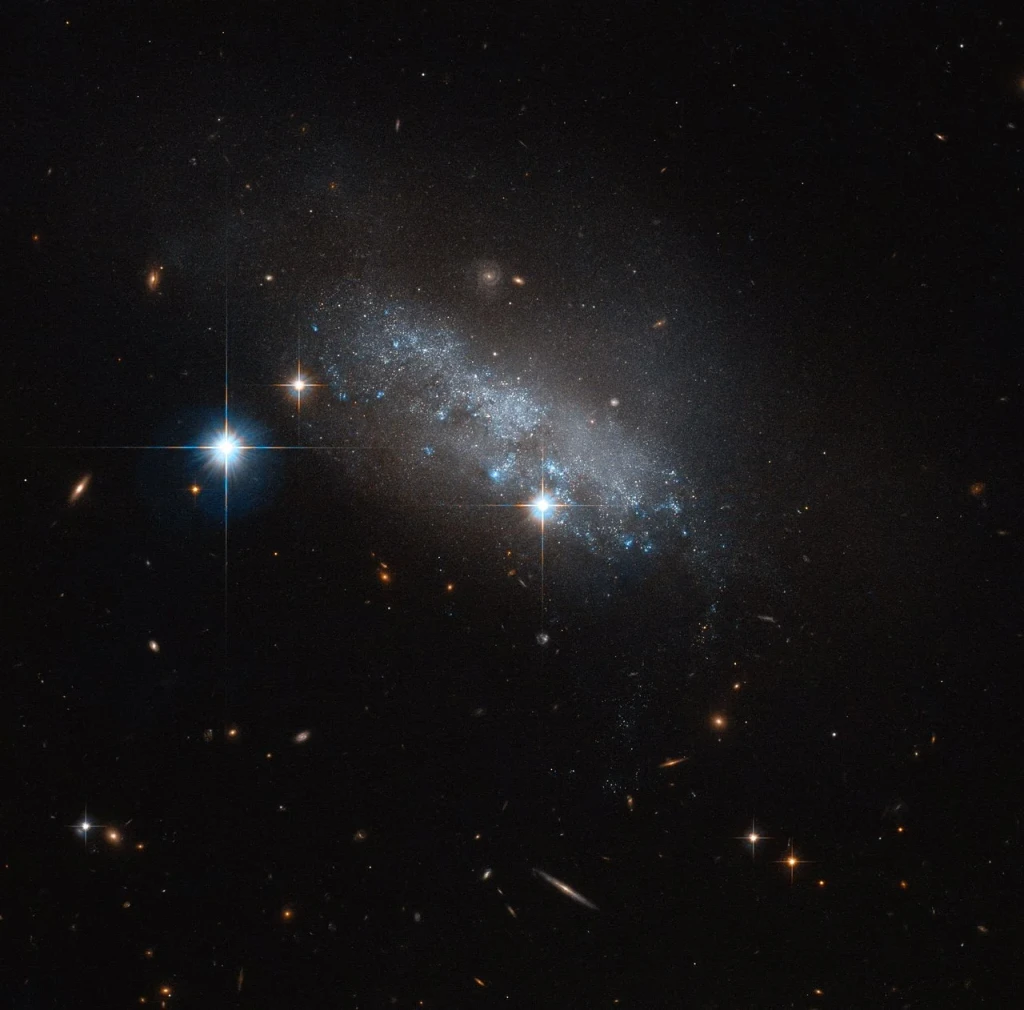
This delicate blue group of stars, actually an irregular galaxy named IC 3583, sits some 30 million light-years away in the constellation of Virgo (The Virgin). It may seem to have no discernable structure, but IC 3583 has been found to have a bar of stars running through its center. These structures are common throughout the Universe, and are found within the majority of spiral, many irregular, and some lenticular galaxies. Two of our closest cosmic neighbors, the Large and Small Magellanic Clouds, are barred, indicating that they may have once been barred spiral galaxies that were disrupted or torn apart by the gravitational pull of the Milky Way.
Researchers at the University of Leicester, England note there are two types of irregular galaxy. Type I's are usually single galaxies of peculiar appearance. They contain a large fraction of young stars, and show the luminous nebulae that are also visible in spiral galaxies. Type II irregulars include the group known as interacting or disrupting galaxies, in which the strange appearance is due to two or more galaxies colliding, merging or otherwise interacting gravitationally. Something similar might be happening with IC 3583. This small galaxy is thought to be gravitationally interacting with one of its neighbors, the spiral Messier 90. Together, the duo form a pairing known as Arp 76. It's still unclear whether these flirtations are the cause of IC 3583's irregular appearance, but whatever the cause, the galaxy makes for a strikingly delicate sight in this NASA/ESA Hubble Space Telescope image, glimmering in the blackness of space.
NASA · GSFC · 2017-12-08 · IC 3583 on Wikipedia
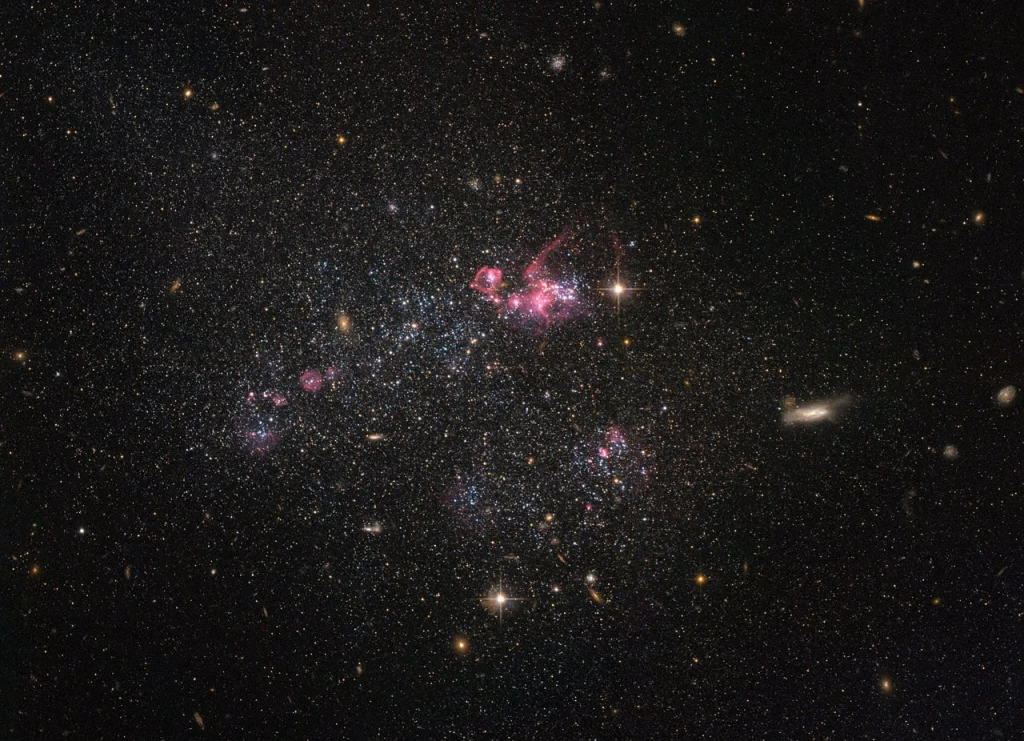
Despite being less famous than their elliptical and spiral galactic cousins, irregular dwarf galaxies, such as the one captured in this NASA/ESA Hubble Space Telescope image, are actually one of the most common types of galaxy in the universe. Known as UGC 4459, this dwarf galaxy is located approximately 11 million light-years away in the constellation of Ursa Major (The Great Bear), a constellation that is also home to the Pinwheel Galaxy (M101), the Owl Nebula (M97), Messier 81, Messier 82 and several other galaxies all part of the M81 group.
UGC 4459's diffused and disorganized appearance is characteristic of an irregular dwarf galaxy. Lacking a distinctive structure or shape, irregular dwarf galaxies are often chaotic in appearance, with neither a nuclear bulge (a huge, tightly packed central group of stars) nor any trace of spiral arms (regions of stars extending from the center of the galaxy). Astronomers suspect that some irregular dwarf galaxies were once spiral or elliptical galaxies, but were later deformed by the gravitational pull of nearby objects.
Rich with young blue stars and older red stars, UGC 4459 has a stellar population of several billion. Though seemingly impressive, this is small when compared to the 200 to 400 billion stars in the Milky Way. Observations with Hubble have shown that because of their low masses, star formation is very low compared to larger galaxies. Only very little of their original gas has been turned into stars. Thus, these small galaxies are interesting to study to better understand primordial environments and the star formation process.
NASA · GSFC · 2017-12-08
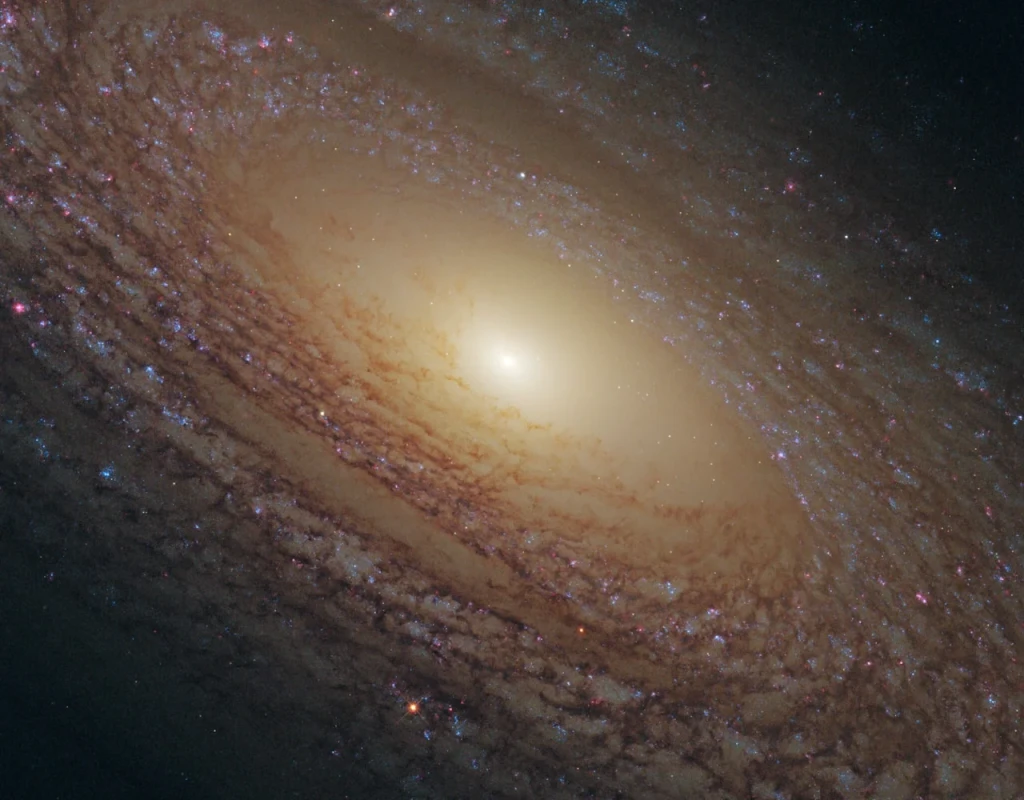
NASA image release Feb. 17, 2011 To see a hd vidoe of this sprial galaxy go to: www.flickr.com/photos/gsfc/5453173577/ The Hubble Space Telescope revealed this majestic disk of stars and dust lanes in this view of the spiral galaxy NGC 2841. A bright cusp of starlight marks the galaxy's center. Spiraling outward are dust lanes that are silhouetted against the population of whitish middle-aged stars. Much younger blue stars trace the spiral arms. Notably missing are pinkish emission nebulae indicative of new star birth. It is likely that the radiation and supersonic winds from fiery, super-hot, young blue stars cleared out the remaining gas (which glows pink), and hence shut down further star formation in the regions in which they were born. NGC 2841 currently has a relatively low star formation rate compared to other spirals that are ablaze with emission nebulae. NGC 2841 lies 46 million light-years away in the constellation of Ursa Major (The Great Bear). This image was taken in 2010 through four different filters on Hubble’s Wide Field Camera 3. Wavelengths range from ultraviolet light through visible light to near-infrared light. NASA, ESA, and the Hubble Heritage (STScI/AURA)-ESA/Hubble Collaboration; Acknowledgment: M. Crockett and S. Kaviraj (Oxford University, UK), R. O’Connell (University of Virginia), B. Whitmore (STScI), and the WFC3 Scientific Oversight Committee NASA Goddard Space Flight Center enables NASA’s mission through four scientific endeavors: Earth Science, Heliophysics, Solar System Exploration, and Astrophysics. Goddard plays a leading role in NASA’s accomplishments by contributing compelling scientific knowledge to advance the Agency’s mission.
NASA · GSFC · 2017-12-08 · NGC 2841 on Wikipedia
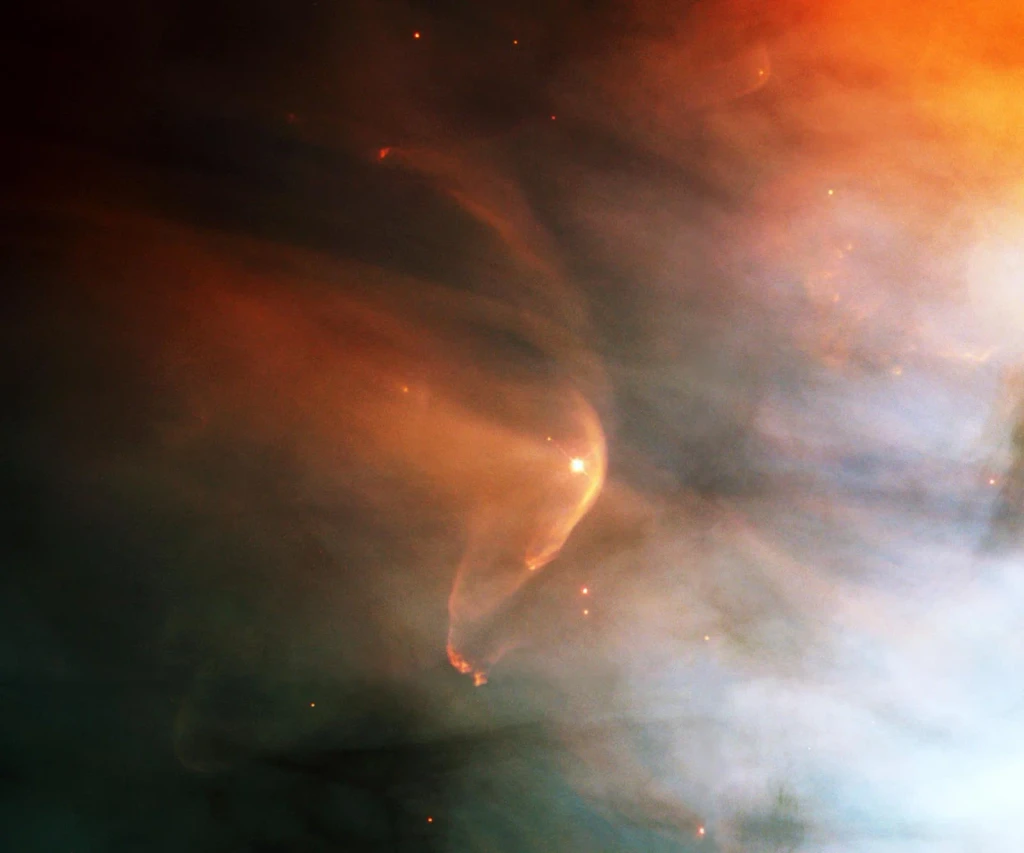
The nearby intense star-forming region known as the Great Nebula in the Orion constellation reveals a bow shock around a very young star as seen by NASA's Hubble Space Telescope (HST). Named for the crescent-shaped wave made by a ship as it moves through the water, a bow shock can be created in space where two streams of gas collide.
LL Ori emits a vigorous solar wind, a stream of charged particles moving rapidly outward from the star. Our own sun has a less energetic version of this wind. The material in the fast wind from LL Ori collides with slow moving gas evaporating away form the center of the Orion Nebula, which is located in the lower right of this image, producing the crescent shaped bow shock seen in the image.
Astronomers have identified numerous shock fronts in this complex star-forming region and are using this data to understand the many complex phenomena associated with the birth of stars. A close visitor in our Milky Way Galaxy, the nebula is only 1,500 light years away from Earth. The filters used in this color composite represent oxygen, nitrogen, and hydrogen emissions.
NASA · MSFC · 1995-02-01 · Orion Nebula on Wikipedia
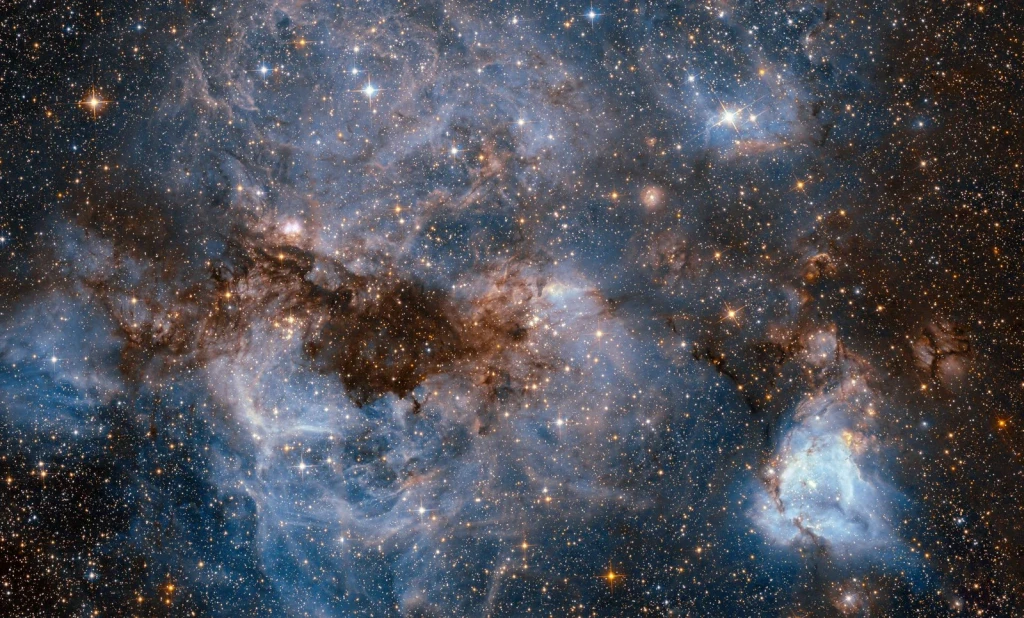
This shot from the NASA/ESA Hubble Space Telescope shows a maelstrom of glowing gas and dark dust within one of the Milky Way’s satellite galaxies, the Large Magellanic Cloud (LMC). This stormy scene shows a stellar nursery known as N159, an HII region over 150 light-years across. N159 contains many hot young stars. These stars are emitting intense ultraviolet light, which causes nearby hydrogen gas to glow, and torrential stellar winds, which are carving out ridges, arcs, and filaments from the surrounding material. At the heart of this cosmic cloud lies the Papillon Nebula, a butterfly-shaped region of nebulosity. This small, dense object is classified as a High-Excitation Blob, and is thought to be tightly linked to the early stages of massive star formation. N159 is located over 160,000 light-years away. It resides just south of the Tarantula Nebula (heic1402), another massive star-forming complex within the LMC. This image comes from Hubble’s Advanced Camera for Surveys. The region was previously imaged by Hubble’s Wide Field Planetary Camera 2, which also resolved the Papillon Nebula for the first time.
NASA · GSFC · 2017-12-08
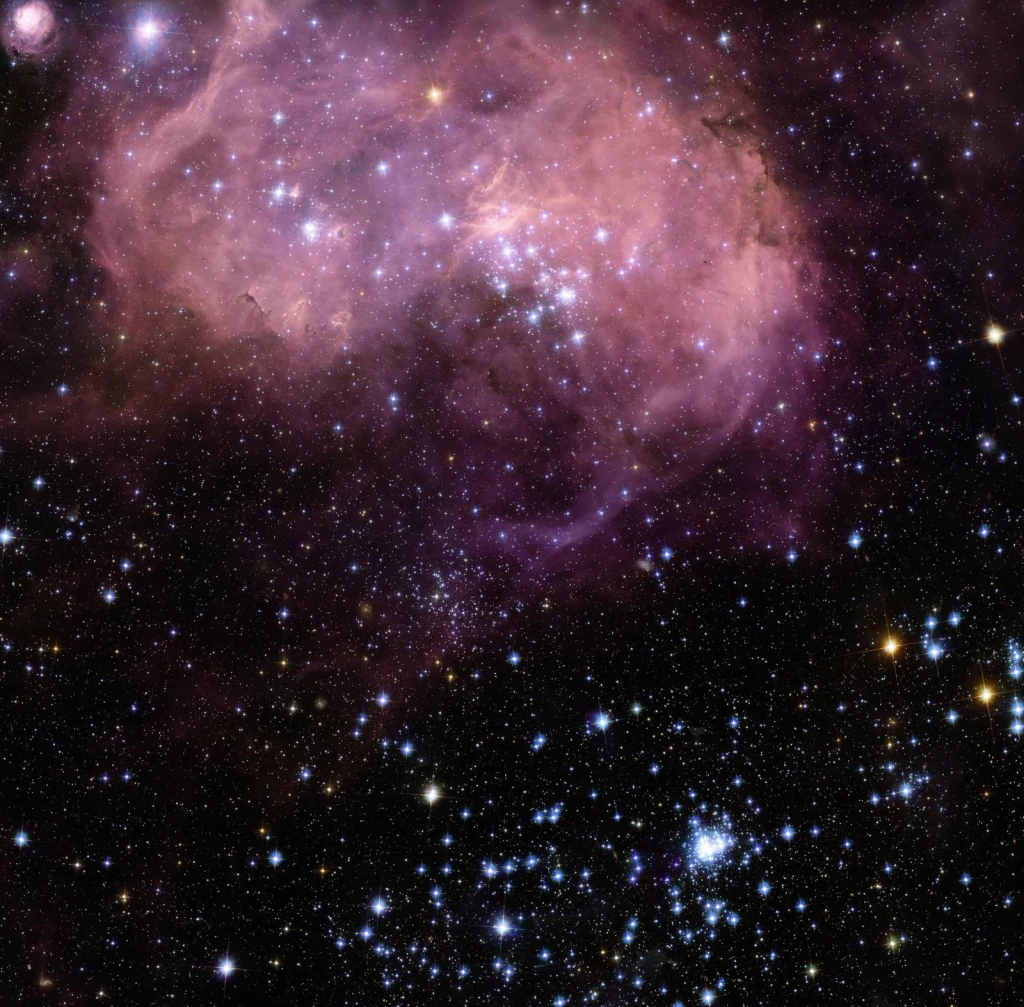
A spectacular new NASA/ESA Hubble Space Telescope image, one of the largest ever released of a star-forming region, highlights N11, part of a complex network of gas clouds and star clusters within our neighbouring galaxy, the Large Magellanic Cloud. This region of energetic star formation is one of the most active in the nearby Universe.
The Large Magellanic Cloud contains many bright bubbles of glowing gas. One of the largest and most spectacular has the name LHA 120-N 11, from its listing in a catalogue compiled by the American astronomer and astronaut Karl Henize in 1956, and is informally known as N11. Close up, the billowing pink clouds of glowing gas make N11 resemble a puffy swirl of fairground candy floss. From further away, its distinctive overall shape led some observers to nickname it the Bean Nebula. The dramatic and colourful features visible in the nebula are the telltale signs of star formation.
N11 is a well-studied region that extends over 1000 light-years. It is the second largest star-forming region within the Large Magellanic Cloud and has produced some of the most massive stars known. Three successive generations of stars, each of which formed further away from the centre of the nebula than the last, have created shells of gas and dust. These shells were blown away from the newborn stars in the turmoil of their energetic birth and early life, creating the ring shapes so prominent in this image.
In the upper left is the red bloom of nebula LHA 120-N 11A. Its rose-like petals of gas and dust are illuminated from within, thanks to the radiation from the massive hot stars at its centre. N11A is relatively compact and dense and is the site of the most recent burst of star development in the region. Other star clusters abound in N11, including NGC 1761 at the bottom of the image, which is a group of massive hot young stars busily pouring intense ultraviolet radiation out into space. Studying these stellar nurseries helps astronomers understand a lot more about how stars are born and their ultimate development and lifespan.
NASA · GSFC · 2017-12-08
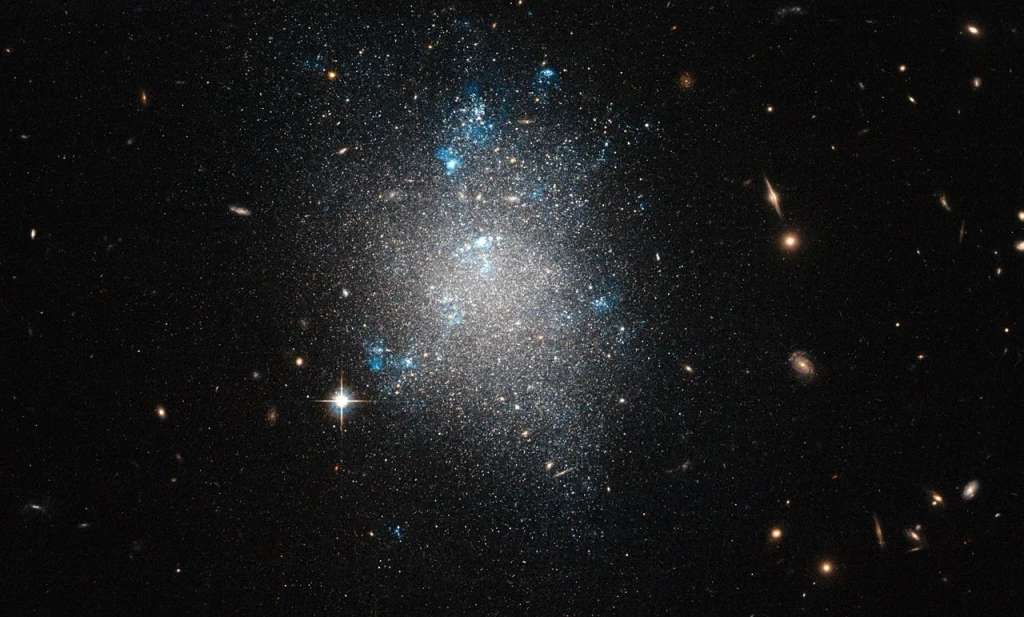
The constellation of Ursa Major (The Great Bear) is home to Messier 101, the Pinwheel Galaxy. Messier 101 is one of the biggest and brightest spiral galaxies in the night sky. Like the Milky Way, Messier 101 is not alone, with smaller dwarf galaxies in its neighborhood. NGC 5477, one of these dwarf galaxies in the Messier 101 group, is the subject of this image from the NASA/ESA Hubble Space Telescope.
Without obvious structure, but with visible signs of ongoing star birth, NGC 5477 looks much like a typical dwarf irregular galaxy. The bright nebulae that extend across much of the galaxy are clouds of glowing hydrogen gas in which new stars are forming. These glow pinkish red in real life, although the selection of green and infrared filters through which this image was taken makes them appear almost white.
The observations were taken as part of a project to measure accurate distances to a range of galaxies within about 30 million light-years from Earth, by studying the brightness of red giant stars. In addition to NGC 5477, the image includes numerous galaxies in the background, including some that are visible right through NGC 5477. This serves as a reminder that galaxies, far from being solid, opaque objects, are actually largely made up of the empty space between their stars. This image is a combination of exposures taken through green and infrared filters using Hubble's Advanced Camera for Surveys.
NASA · GSFC · 2017-12-08 · Pinwheel Galaxy on Wikipedia
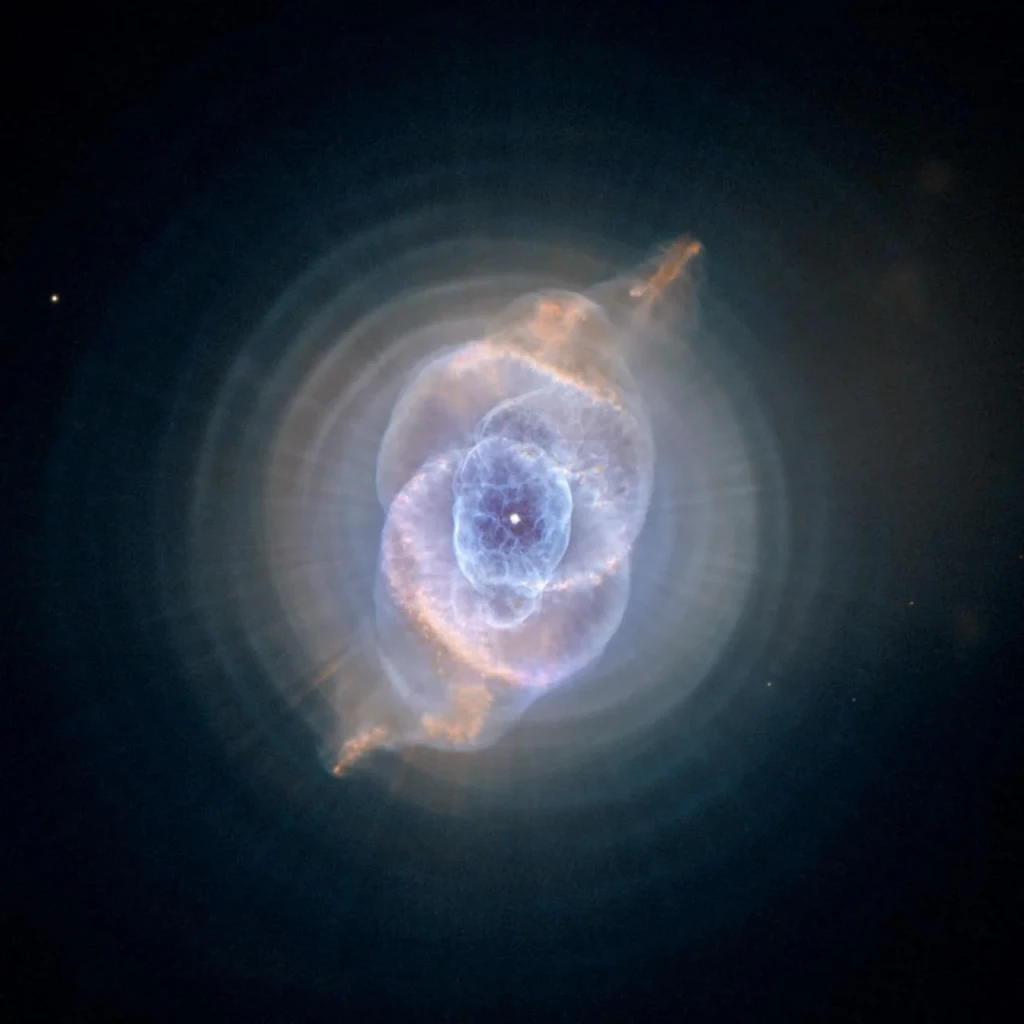
The Cat's Eye Nebula, one of the first planetary nebulae discovered, also has one of the most complex forms known to this kind of nebula. Eleven rings, or shells, of gas make up the Cat's Eye. The full beauty of the Cat's Eye Nebula is revealed in this detailed view from NASA's Hubble Space Telescope.
The image from Hubble's Advanced Camera for Surveys (ACS) shows a bull's eye pattern of eleven or even more concentric rings, or shells, around the Cat's Eye. Each 'ring' is actually the edge of a spherical bubble seen projected onto the sky. That's why it appears bright along its outer edge. Observations suggest the star ejected its mass in a series of pulses at 1,500-year intervals. These convulsions created dust shells, each of which contain as much mass as all of the planets in our solar system combined. Still, this is only one percent of the Sun's mass. These concentric shells make a layered, onion-skin structure around the dying star. The view from Hubble is like seeing an onion cut in half, where each skin layer is discernible.
The bull's-eye patterns seen around planetary nebulae come as a surprise to astronomers because they had no expectation that episodes of mass loss at the end of stellar lives would repeat every 1,500 years. Several explanations have been proposed, including cycles of magnetic activity somewhat similar to our own Sun's sunspot cycle, the action of companion stars orbiting around the dying star, and stellar pulsations. Another school of thought is that the material is ejected smoothly from the star, and the rings are created later on due to formation of waves in the outflowing material.
NASA · GSFC · 2017-12-08 · Cat's Eye Nebula on Wikipedia
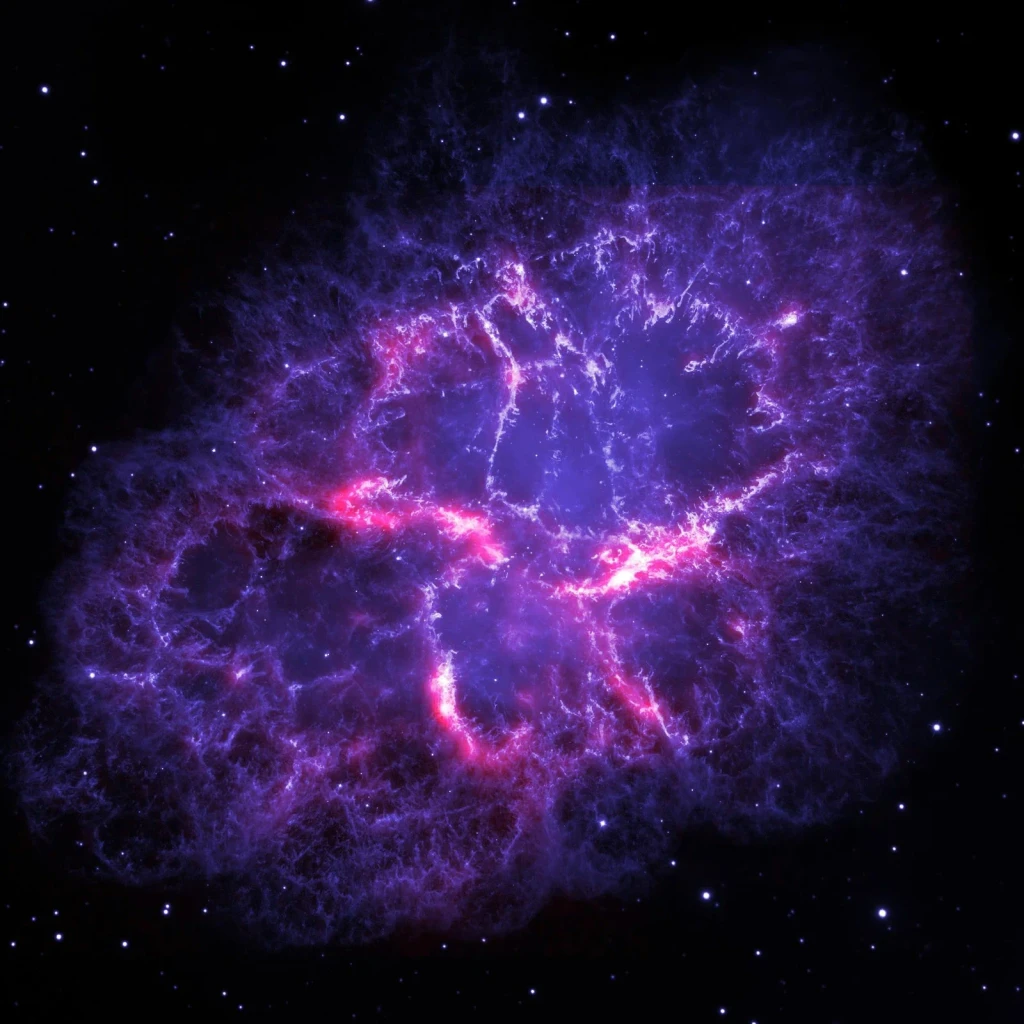
This image shows a composite view of the Crab nebula, an iconic supernova remnant in our Milky Way galaxy, as viewed by the Herschel Space Observatory and the Hubble Space Telescope.
NASA · JPL · 2013-12-12 · Crab Nebula on Wikipedia
